
A municipal stadium, a multi-sports hall, a swimming pool, a skate park or even a playground are perfect places for a nest to go unnoticed… until the day activity resumes: training, competitions, children, spectators, lawnmower, maintenance work. And it is often then that incidents occur: proximity, vibrations, repeated passages.
The goal here is simple: reduce the risk, avoid “bad reflexes”, and know who to contact depending on whether the nest is on public or private property.
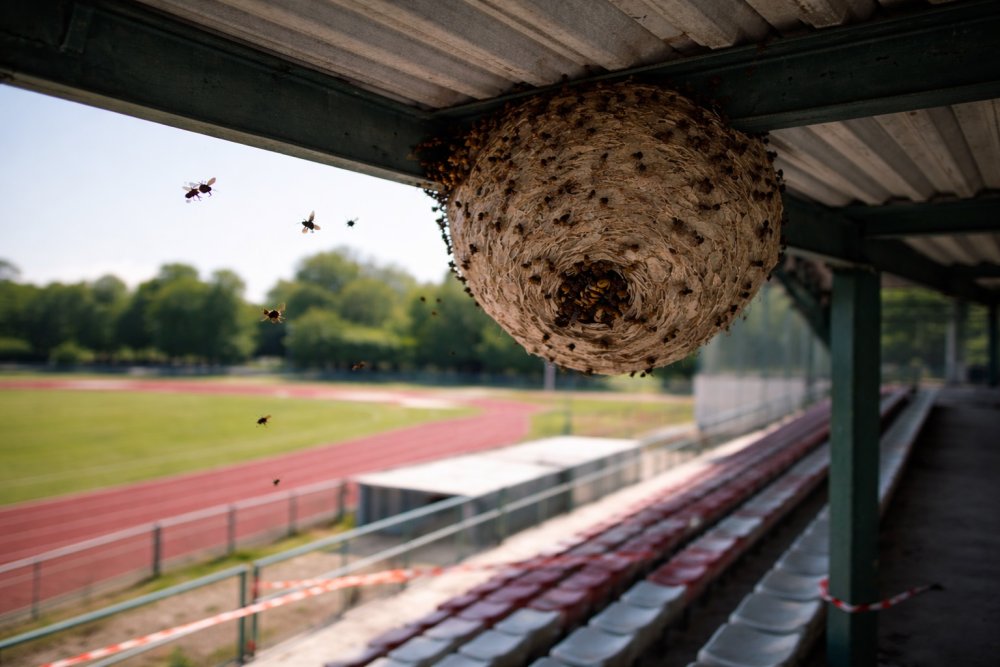
Table des matières
1) Why nests are found near stadiums, gyms, swimming pools
Wasps and some hornets look for:
- sheltered areas (awnings, attics, cladding, technical rooms),
- water points (swimming pools, wetlands),
- trees and hedges bordering fields,
- infrequently visited spaces off-season.
On sports facilities, you often find “ideal” spots: stands, sheds, panels, boxes, frameworks, embankments, dividing hedges.
2) The 5 immediate reflexes (those that prevent accidents)
- Do not approach: keep a safe distance (5 meters is a reference often used in safety instructions).
- Do not attempt to destroy the nest yourself (consumer sprays, fire, water, sticks…): this is the best way to trigger a defense.
- Keep the public away: children, athletes, spectators.
- Identify without provoking: if possible, take a photo from a distance + precise location (north stand, lighting pole, technical room…).
- Alert the right authority: the procedure mainly depends on public vs private.
3) Public domain vs private domain: who manages what?
- On public domain (municipal stadium, school, communal playground, city gymnasium, public road): the town hall is generally the first contact and can commission a service provider.
- On private domain (private club, private property adjacent to the stadium, residence, company): it is up to the owner/manager to call in a professional. The reflex: contact ALLO FRELONS. Wherever you are in France, ALLO FRELONS is the reference professional for everything concerning wasps and hornets.
➡️ When in doubt: if it is a public facility or a very frequented place, contact the town hall (or the municipality’s hygiene/safety service): many local instructions go in this direction. It is the town hall or the local authority that will cover the cost of the ALLO FRELONS intervention.
4) Practical cases (sports facilities)
A) Nest under a stand / awning / roof
Risk: vibrations (public), repeated passages, maintenance work.
Action: mark off the area, limit access, report to the manager/town hall.
B) Nest in a hedge at the edge of a field / embankment
Risk: mowing, trimming, ball ending up in the hedge, children.
Action: stop maintenance on direct contact, create a perimeter, call.
C) Nest near a swimming pool / water point
Risk: comings and goings, wet areas, technical rooms.
Action: same + caution with closed rooms (where access may be tricky).
5) When to call in a professional (and why it changes everything)
A professional will adapt:
- the diagnosis (probable species, actual location, accessibility),
- the safety perimeter,
- the intervention method depending on the environment (public, school, stadium…),
- the risk of fallout (e.g., products, residues, safety of residents).
In places open to the public, the logic is: secure, document the decision, avoid improvisation. (This is also what some recommendations emphasize: establish a perimeter, inform, limit people’s exposure).
6) Three local examples
✅ In Toulouse: sports facilities + seasonal vigilance
If the nest is spotted near a field, stadium, or gymnasium, the key is to act quickly without provoking the nest, especially during active periods. For a local intervention: disinsection / nest destruction in Toulouse → https://allo-frelons.fr/destruction-nids-frelons-toulouse
✅ In Agen: watch out for hedges, sheds, field shelters
Around fields and sports grounds, nests are often in “technical” areas (shelters, cladding, hedges, embankments). For handling in the area: wasp/hornet intervention in Agen (47000) → https://allo-frelons.fr/agen-47000-destruction-des-nids-de-guepes-frelons-et-frelons-asiatiques
✅ In Paris: access constraints, condominiums, buildings
In dense areas, the challenge is often access (height, roof, courtyards, buildings), and coordination between manager/condominium. For intervention in Paris: hornet and wasp company in Paris (75) → https://allo-frelons.fr/entreprise-frelons-guepes-frelon-asiatique-paris-75
7) Mini-FAQ
Do firefighters intervene?
Depending on the departments and situations (immediate danger / public place), practices vary. The right reflex: town hall/manager first for public areas.
What distance should be respected?
As a precaution, several public guidelines mention 5 meters as the minimal reference around a nest.
Can we treat “just a small nest” ourselves?
On a sports facility, the risk (public, children, incidents) almost always justifies a supervised intervention rather than an amateur attempt.