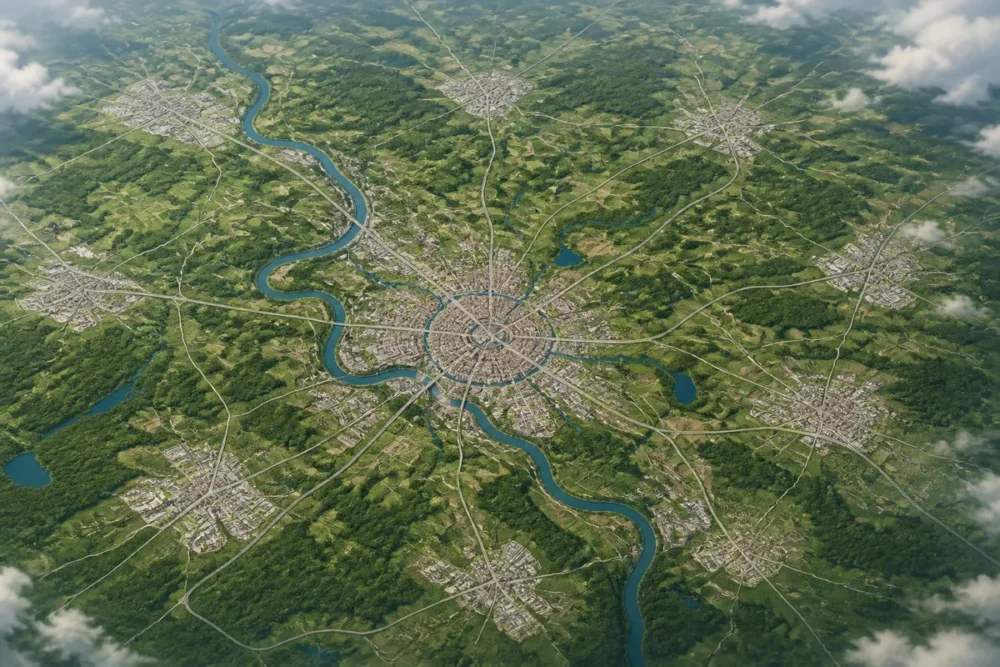
The Moselle is much better understood when starting from a simple point: Metz serves as the pivot for the entire department 57. On a department map, the city immediately gives you the scale, the main routes, and the overall logic. The rest of the territory then becomes more readable, including the most well-known Moselle cities.
The subject may seem administrative, but it is also very concrete. Moselle is not just a department name: it is a border territory, structured by relay cities, living areas, routes towards Luxembourg and Germany, and a history that still leaves visible traces. In other words, if you know where Metz is located, you have already done half the work.

Table des matières
In brief
🧭 Metz is the best anchor point to read Moselle and its organization.
🗺️ The Moselle cities do not all play the same role: some are administrative, others border or transit cities.
🚆 The department 57 is also identified by its borders, traffic routes, and relay cities.
📍 To understand the territory, you must read the department map as a whole, not just as a simple list of municipalities.
How to locate Metz on the department map?
Metz is located as the center of gravity of Moselle: it is the prefecture of department 57, the municipality that hosts the prefecture, and the best starting point to read the department map. Starting from Metz, one quickly understands the routes to Thionville, Forbach, Sarreguemines, or Sarrebourg.
Metz is not just a large city: it is the administrative, urban, and symbolic landmark of the department. According to Insee, Metz is the prefecture of Moselle, identified by the official geographic code 57, in the Grand Est region. The department borders Luxembourg and Germany, which greatly changes the way it is read.
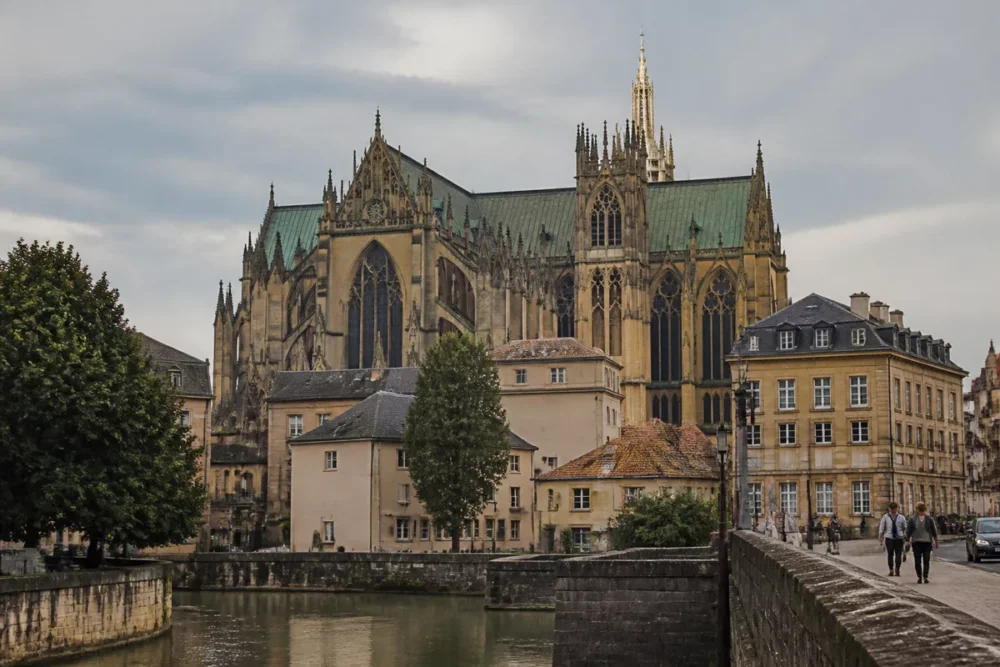
In the center of Metz, a single monument is often enough to put things in perspective: the Saint-Étienne Cathedral. It acts as a visual landmark, almost like a stone compass, and reminds that Metz concentrates both history, administrative functions, and a large part of the department’s services.

For a more complete administrative reference, this summary guide https://www.abc-france.net/blog/departement-57-comprendre-la-moselle-sa-prefecture-metz-et-les-villes-a-connaitre/ helps link the prefecture, code 57, and the cities to know without losing track.
What are the main cities of Moselle?
The main cities of Moselle do not play the same role. Metz concentrates administration and culture, Thionville handles flows towards Luxembourg, Forbach the Germanic side, Sarreguemines the Saar valley, and Saint-Avold or Sarrebourg serve as traffic relay points.
If you want to avoid a too vague mental map, you have to think in terms of functions. A Moselle city can be an administrative center, a border gateway, an industrial city in transition, or a transit hub. This approach is more useful than a simple ranking by population because it explains why the department functions as a network.
| City | Geographical reference | Main role | What it tells about Moselle |
|---|---|---|---|
| Metz | Center of the department | Prefecture, culture, services | The administrative and symbolic heart of the 57 |
| Thionville | Northwest, towards Luxembourg | Border and mobility city | Moselle oriented towards daily exchanges |
| Forbach | East, towards Germany | Border and industrial city | The department seen from the Saar basin |
| Sarreguemines | Saar valley | Heritage, river, local life | A more riverine and heritage-rich Moselle |
| Saint-Avold | Between Metz and Forbach | Traffic relay | A strategic transit point in the center-east |
| Sarrebourg | Southeast, towards the Vosges | Transition city | The link between urban Moselle and more natural Moselle |
To read these Moselle cities without error, keep three simple filters in mind:
- function: administration, border, industry, heritage or transit;
- position: northern border, departmental center or more forested south;
- use: living there, working there, visiting or passing through.
This sorting avoids a common misunderstanding: believing that all cities have the same weight in the department. In practice, Moselle functions more like a set of complementary poles. This is also why a selection of French castles or a heritage reading in stages can very well complement a visit focused on Metz.
Why is Moselle also read through its borders?
Moselle is not just a line on a map: it is a department of passages, borders, and urban centers.
The north and east of the department tell much more than a simple administrative division. Exchanges with Luxembourg and Germany influence mobility, jobs, travel habits, and even the hierarchy of cities. This explains the very particular place of Thionville and Forbach, two municipalities that look beyond the local scale alone.
The territory also has an industrial memory and a Lorraine identity that remain clearly visible. This gives Moselle a somewhat unique profile in the Grand Est region: less linear than a plain department, more contrasted than a textbook map, and above all more readable when you accept the idea of a border territory rather than a simple homogeneous block.
If you are looking to compare cities from the perspective of daily life, the viewpoint offered by French cities in everyday life can provide a useful counterpoint: you then better see what makes Metz, Thionville, or Sarreguemines more or less practical depending on the profiles.
A common mistake is to confuse the Moselle department with the Moselle river. The two are linked, but they are not the same geographical entity.
How to read the map of department 57 without making mistakes?
To read the map of department 57, always start from Metz, then project the other cities according to their function. Thionville and Forbach are gateways to the borders, Sarreguemines follows the Saar valley, and Sarrebourg marks the transition to a more forested and Vosges area.
The right method consists of four simple reflexes. First, identify the center: Metz. Next, locate the border hubs in the northwest and east. Then read the valleys and traffic routes. Finally, check if the city studied is a service hub, a transit point, or a tourist destination.
- Start with Metz, to understand the administrative organization.
- Then look at Thionville, if your reading concerns the northwestern border area.
- Move on to Forbach and Sarreguemines for the eastern axis and the Saar dimension.
- Finish with Sarrebourg if you are looking for the shift towards a more natural landscape.
The point of caution is simple: on a department map, it is easy to confuse a transit hub with a major center. Yet, a city can be very useful for circulation without being the most central in the organization of Moselle.
This reading is also the most effective if you are preparing a trip. For example, a professional round trip is not thought of like a heritage visit, and a weekend in Moselle is not planned like a cross-border journey. Hence the interest in distinguishing uses before choosing your base city.
What to see around Metz to understand Moselle in a short time?
To grasp the spirit of Moselle without spending a week there, Metz remains the best base camp. The city allows you to combine the historic center, religious architecture, major cultural facilities, and quick access to other hubs in the department. In a well-organized day, you already have a solid reading of the territory.
- Metz for the prefecture, the old town, and major urban functions;
- Thionville to understand the importance of the Luxembourg corridor;
- Sarreguemines for reading the valley and river heritage;
- Sarrebourg to see the transition between urban Moselle and greener Moselle.
If you like heritage routes, a detour through a selection of French castles fits very well into a visit to Moselle, especially if you combine Metz with some fortified sites or border landscapes. The logic of the department is precisely there: you quickly go from an urban center to a much more rural setting.
And if your angle is more focused on daily life, the department also offers cities where mobility, facilities, and home-work commutes are decisive. This is the kind of criterion that helps to choose a base for a stay, but also a place to settle, without being blinded by the names of only the most well-known cities.
Key Takeaways
🧭 Metz is the best starting point to understand Moselle.

🗺️ The department map is read by hubs, borders, and traffic routes.
🚆 The cities of Moselle do not all have the same role: some are relays, others are centers.
📍 The department 57 is distinguished by its cross-border anchoring and network organization.
🏛️ To understand the territory, one must distinguish the prefecture, border towns, and transition towns.
FAQ
Is Metz the prefecture of Moselle?
Yes, Metz is indeed the capital of Moselle. It is the city to prioritize if you are looking for the administrative center of department 57. It also structures a large part of the territory’s travel and public services.
Which Moselle cities should be known first?
Metz comes first, then Thionville, Forbach, Sarreguemines, Saint-Avold, and Sarrebourg depending on the perspective. The right approach is to classify them by role: border, administration, traffic, heritage, or transition to other areas.

Is Moselle mainly a border department?
Yes, and that is what makes it special. Luxembourg and Germany strongly influence its mobility and some of its cities. This border dimension is especially visible in the northwest and east, around major routes and living areas.

How to avoid confusing Moselle and Metz on a map?
You have to start from the principle that Metz is a point within Moselle, not the other way around. Metz serves as a central landmark, while Moselle refers to the entire department. Once this mindset is acquired, reading becomes much easier.
Does the map of department 57 help organize a visit?
Yes, because it allows grouping visits by area. You can do Metz alone, then add a border town or a more heritage-oriented site. It is more logical than zigzagging from one end of the department to the other without a starting point.