
A balanced diet does not necessarily fail because you lack willpower. Very often, the real causes are more subtle: poorly estimated portions, skipped meals, lack of fiber, stress-related snacking, sugary drinks, or ultra-processed products that give the impression of “eating well” without truly supporting satiety.
The most common balanced diet mistakes therefore do not come from a single “forbidden” food, but from a set of repeated habits. The goal of this article is simple: to understand why these mistakes prevent progress, then correct them with realistic guidelines, compatible with on-the-go meals, less structured weekends, and days when organization gets a bit chaotic.
Table des matières
In Brief
🍽️ Dietary balance is judged over several meals, not on a single plate. An occasional slip counts less than an overall consistent routine.
⚠️ The most common mistakes often concern portions, lack of fiber, protein, excess highly processed foods, and skipped meals.
🥦 A balanced meal becomes simpler when it combines vegetables, quality starches, protein sources, useful fats, and hydration.
🧭 The right correction is not perfection: it is an organization flexible enough to hold up in real life, even with stress, a limited budget, or little time.
Understanding What a Balanced Diet Really Is
A balanced diet is not a series of perfect days. It is rather a progressive construction, where variety, regularity, and the overall quality of choices end up weighing more than the detail of a single meal. In other words, eating a pizza on a Friday night does not “ruin” a coherent week; however, regularly skipping lunch then compensating in the evening can unbalance the whole.
The guidelines from Santé publique France, via the Manger Bouger website, emphasize especially the place of fruits and vegetables, legumes, whole starches, water as the main drink, as well as limiting sugary, salty, and fatty products. These guidelines are not designed as a punishment, but as a compass.
A Balance Judged Over Time
The classic trap is to evaluate one’s diet meal by meal: “I ate too much fat at lunch,” “I didn’t have enough vegetables,” “I gave in to a dessert.” This microscopic reading quickly creates guilt. Yet, balance is built mainly on repetition: what you do most often counts more than what you do occasionally.
Variety, Satiety, and Regularity: The Trio That Changes Everything
Variety helps cover nutritional needs. Satiety prevents experiencing eating as a constant struggle against hunger. Regularity limits harsh compensations: when meals are too far apart or too light, the body often demands energy-dense, easy-to-eat, and poorly satiating foods more quickly.
A balanced diet should not require perfection: it should above all allow you to cope without excessive hunger, without constant guilt, and without impossible rules.
What Are the Most Common Balanced Diet Mistakes?
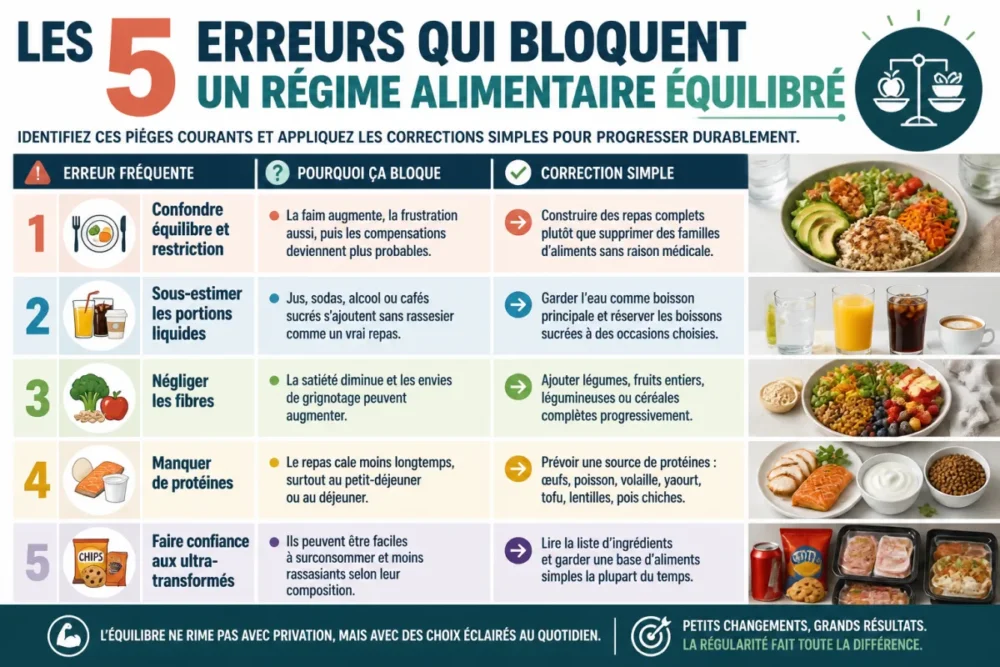
The most common mistakes are rarely spectacular. They hide in habits: believing that a “light” product is necessarily interesting, forgetting caloric drinks, eating too fast, lacking protein at breakfast, or reducing starches to the point of being hungry two hours later.
In practice, these dietary mistakes cause problems because they blur hunger and satiety signals. You feel like you are making efforts, but the meals are not complete enough, not regular enough, or not satiating enough. Result: progress becomes fragile, especially when stress, invitations, irregular schedules, or fatigue arise.
| Common Mistake | Why It Gets Stuck | Simple Correction |
|---|---|---|
| Confusing balance and restriction | Hunger increases, frustration too, then compensations become more likely. | Build complete meals rather than removing food groups without medical reason. |
| Underestimating liquid portions | Juices, sodas, alcohol, or sweetened coffees add up without satisfying like a real meal. | Keep water as the main drink and reserve sweetened beverages for chosen occasions. |
| Neglecting fiber | Satiation decreases and snacking cravings may increase. | Gradually add vegetables, whole fruits, legumes, or whole grains. |
| Lacking protein | The meal keeps you full for less time, especially at breakfast or lunch. | Include a protein source: eggs, fish, poultry, yogurt, tofu, lentils, chickpeas. |
| Trusting ultra-processed foods | They can be easy to overconsume and less filling depending on their composition. | Read the ingredient list and mostly keep a base of simple foods. |
Confusing balanced eating and restriction
This is one of the most persistent mistakes: wanting to “eat balanced” becomes synonymous with removing. Less bread, less pasta, less fat, less pleasure. Yet, removing without rebuilding a coherent meal often creates the opposite effect: hunger, irritability, food obsession, then the desire to compensate with very sweet or very fatty foods.
Underestimating liquid portions and calories
Portions are difficult to assess, especially when eating quickly, in front of a screen, or directly from packaging. Drinks pose another problem: they can provide energy without triggering the same satiety as solid food. Not to mention alcohol, which can also alter food choices around the meal.
Neglecting fiber, protein, and quality fats
A “light” meal is not always a balanced meal. A salad made only of raw vegetables, for example, may seem virtuous but lack protein, starches, or useful fats. It fills little, and hunger returns quickly. Conversely, a simple plate with vegetables, lentils, brown rice, rapeseed or olive oil, and a fruit can be much more stable.
Why are these mistakes so common in daily life?
These mistakes are widespread because they stick to real life: little time to cook, stress, meals eaten out, social media influence, quick promises, and confusion between slimness, health, and performance. The problem is therefore not only nutritional; it is also practical, social, and emotional.
Preconceived ideas play a huge role. Many people still think that a balanced meal must be very light, that starches necessarily make you gain weight, or that sugar must be completely banned. This type of belief leads to extreme decisions, whereas balanced eating is rather based on proportions, frequency, and the overall context.
Lack of time turns good principles into headaches
When the fridge is empty and the lunch break lasts fifteen minutes, the best nutritional principles become less obvious. This is where minimal organization makes all the difference: having a few backup foods, preparing a base of starches or vegetables, keeping eggs, canned fish, legumes, or plain yogurts allows you to put together a decent meal without starting from scratch.
Stress changes food choices
Stress does not just make you “eat more” or “eat less.” It can especially push you towards quicker, more rewarding, and less structured foods. It is also in these moments that we sometimes confuse fatigue, the need for a break, mild dehydration, and real hunger. In these moments, it is useful to distinguish real hunger, fatigue, the need for a break, and automatic habits.
- Planning a proper lunch often prevents automatic snacking in the late afternoon.
- Drinking water regularly limits confusion between thirst, fatigue, and sugar cravings.
- Keeping a simple snack can help when meals are spaced out: fruit, yogurt, a handful of nuts depending on needs.
- Avoiding grocery shopping while hungry reduces impulsive purchases of very dense foods.
The best dietary strategy is not the one that seems perfect on paper, but the one you can repeat during a normal week.
How to correct without falling into food obsession?
The most effective correction is to add structure before removing foods. A balanced meal benefits from being thought of in simple blocks: vegetables, proteins, quality starches, useful fats, water. This logic avoids rigid rules and provides an easy framework to adapt.
Rather than aiming for flawless eating, it is better to seek meals that are sufficiently complete to avoid large fluctuations in hunger. It is less spectacular than a radical method, but much more compatible with the long term. And this is precisely what most attempts lack: a simple, repeatable routine, not heroic motivation.
Building a satisfying plate
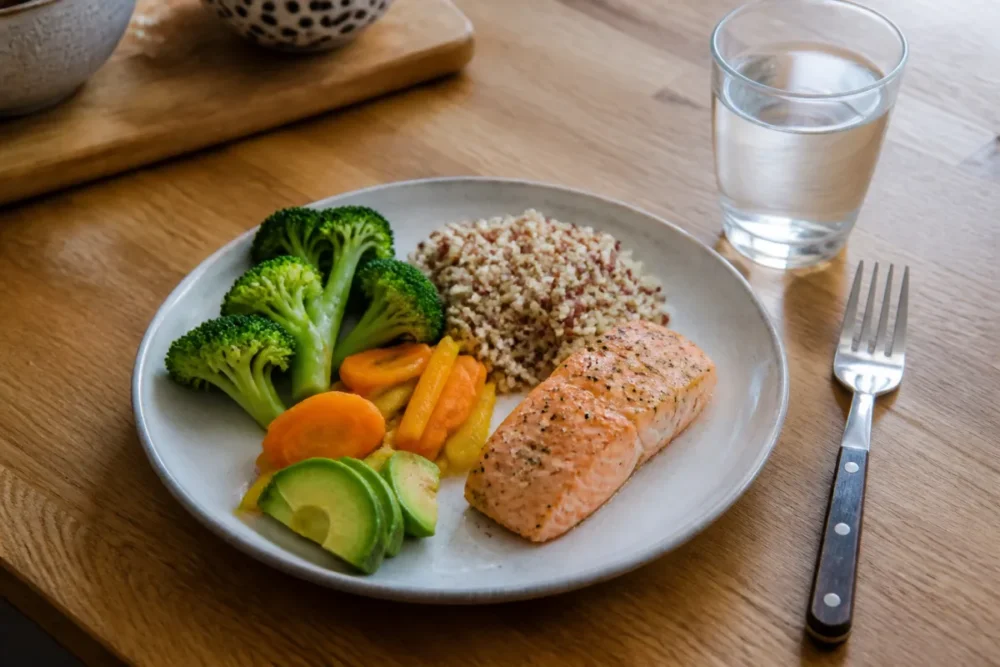
A satisfying plate does not need to be complicated. It must above all contain several functions: nourish, fill, provide micronutrients, and remain enjoyable. Vegetables provide volume and fiber; proteins contribute to satiety; starches, especially whole or minimally refined, provide energy; quality fats improve taste and contribute to overall balance.
- Start with a portion of raw or cooked vegetables, depending on what you have on hand.
- Add a source of animal or plant protein: eggs, fish, poultry, tofu, lentils, red beans.
- Complete with a starch: potatoes, rice, pasta, semolina, whole grain bread, quinoa, or legumes.
- Add a small amount of quality fat: olive oil, canola, nuts, avocado according to taste.
- Finish with water, then a fruit or a dairy product if it matches your hunger.
Organizing the week without a military menu
Organization does not need to look like a strict grid. A more flexible method is to plan three or four bases: a source of vegetables, a source of protein, a starch, a quick option. For example, roasted vegetables, rice, chickpeas, and eggs can become several different meals with sauces, spices, or herbs.
Reading hunger and satiety signals
Eating balanced is not ignoring your body. On the contrary, hunger and satiety signals are useful information. If you are hungry very soon after a meal, it is not necessarily a lack of discipline: the meal may have been too low in fiber, protein, or energy. If you often want to snack in the evening, lunch may have been too light or too quick.
What current nutritional guidelines remind us
Public guidelines do not provide a single menu, but a direction: more raw or minimally processed foods, more plants, legumes, and whole grains, fewer sugary drinks, very salty, very fatty, or very sugary products. They also remind us that a food should not be judged alone, but in its context.
The National Nutrition Health Program, relayed by Public Health France, emphasizes accessible habits: increasing certain protective foods, moving towards better choices when possible, and reducing what takes up too much space in the diet. This approach is interesting because it avoids all-or-nothing. It does not require transforming one's entire diet overnight.
The same food can have different effects depending on the context
Pasta on a plate with vegetables, tuna, olive oil, and fruit does not play the same role as a huge portion of pasta eaten alone very quickly in the evening after skipping lunch. The problem is therefore not "pasta," but the portion, the accompaniment, the day's rhythm, and hunger at mealtime.
Light products are not always the best answer
A light product can be useful in some cases, but it does not automatically guarantee a better balance. Some highly processed foods remain not very filling, even with less sugar or less fat. The right reflex is to look at the whole: ingredient list, frequency of consumption, place in the meal, and effect on satiety.
When should dietary guidelines be adapted?
General guidelines should be adapted when needs change: sustained physical activity, pregnancy, advanced age, pathology, treatment, digestive disorders, history of eating disorders, or specific sports goals. In these cases, professional advice becomes preferable to a rule found at random.
A very active person will not have the same needs as a sedentary person. A teenager, an elderly person, a pregnant woman, or a person living with a chronic illness may have specific guidelines. The challenge is therefore to distinguish general advice, useful for the majority, from personalized support, necessary when the context requires it.
Signals that justify seeking personalized advice
An informational article does not replace a medical or dietary consultation. If food becomes a source of anxiety, if significant restrictions set in, if weight varies greatly without explanation, or if persistent digestive symptoms appear, it is better to talk to a doctor, a dietitian-nutritionist, or a qualified health professional.
- Persistent fatigue despite proper sleep and regular meals.
- Rapid weight loss or gain without clear voluntary change.
- Avoidance of many food groups without medical indication.
- Binge eating, intense guilt, or fear of eating certain foods.
- Known pathology requiring nutritional adaptation.
Useful sources to consult
| Source | Useful data | Practical use | Warning |
|---|---|---|---|
| Manger Bouger — Public Health France | Dietary guidelines from the National Nutrition Health Program. | Identify major food groups to favor or limit. | Guidelines remain general and must be adapted to medical situations. |
| ANSES — recommendations on diet and physical activity | Scientific framework on diet, physical activity, and sedentary behavior. | Understand nutritional principles beyond fad diets. | Scientific opinions do not replace individual follow-up. |
| Ameli — dietary balance | Prevention information on dietary balance in adults. | Check health basics and situations requiring medical advice. | To be supplemented by a professional in case of illness or specific needs. |
Key Takeaways
- 🥗 Dietary balance is built over time, not from a single isolated meal.
- ⚖️ Portions, sugary drinks, and skipped meals explain many subtle failures.
- 🌾 Fiber, protein, and quality starches improve daily satiety.
- 🧘 Flexibility helps maintain habits longer than strict restriction.
- 🩺 Professional advice remains necessary in case of medical conditions or eating disorders.
FAQ
Does one unbalanced meal ruin the whole day?
No. A richer or less structured meal does not ruin overall balance. The most useful thing is simply to return to your usual routine at the next meal, without extreme compensation or punitive restriction.
Should sugar be banned to have a balanced diet?
It is generally not necessary to completely ban sugar. The key factors are frequency, quantity, and context: an occasional pastry does not have the same impact as a significant daily consumption of sugary drinks and highly processed products.
How can I tell if my meal is balanced?
A good guideline is to check if it contains a source of vegetables or fruits, a source of protein, a starch suitable for your hunger, a quality fat, and water. If you are hungry again very quickly afterward, it may be missing a satiating element.
Do starches prevent progress?
No, starches are not a problem in themselves. They mainly become unbalancing when portions are very large, when consumed alone, or when they systematically replace vegetables, proteins, and fiber.
How to maintain good habits without frustration?
The simplest approach is to aim for a regular base rather than constant control. Keep complete meals most of the time, plan quick options, and allow pleasure foods without turning them into failures.