Buying a condominium property is not just about comparing a price per square meter. Condominium fees can change the monthly budget, reveal the actual condition of the building, and indicate upcoming work. In other words, they are part of the purchase price, even if they do not appear in the listing.
The real challenge is therefore not to look for “low” fees at all costs. You need to understand what they finance, how they are allocated, whether they are consistent with the building, and if they are likely to increase after purchase. This understanding helps avoid unpleasant surprises, especially when the apartment seems attractive at first glance.
Table des matières
In brief
🔎 Condominium fees finance the ongoing operation, maintenance, and certain common equipment of the building.
🏢 A low amount may hide deferred maintenance, while a high amount may reflect a better-equipped or better-managed building.
📄 Before buying, ask for the forecast budget, the latest general assembly minutes, and the history of calls for funds.
⚠️ The right question is not “how much does it cost?”, but “why does it cost this amount, and what is likely to change?”.
What do condominium fees really finance?
Condominium fees are used to pay for the expenses necessary for the proper functioning of the building. Service-Public reminds that they are collectively borne by the co-owners, while the ANIL distinguishes expenses related to administration, maintenance, conservation, and those linked to collective services.

To read a receipt or a budget, you have to think in blocks. Some expenses are recurrent and visible, others are less spectacular but strongly structure the real cost: property management, maintenance, insurance, water, collective heating, elevator, security, or voted works. It is the combination of these items that causes condominium fees to vary, much more than an isolated figure.

The main items to identify
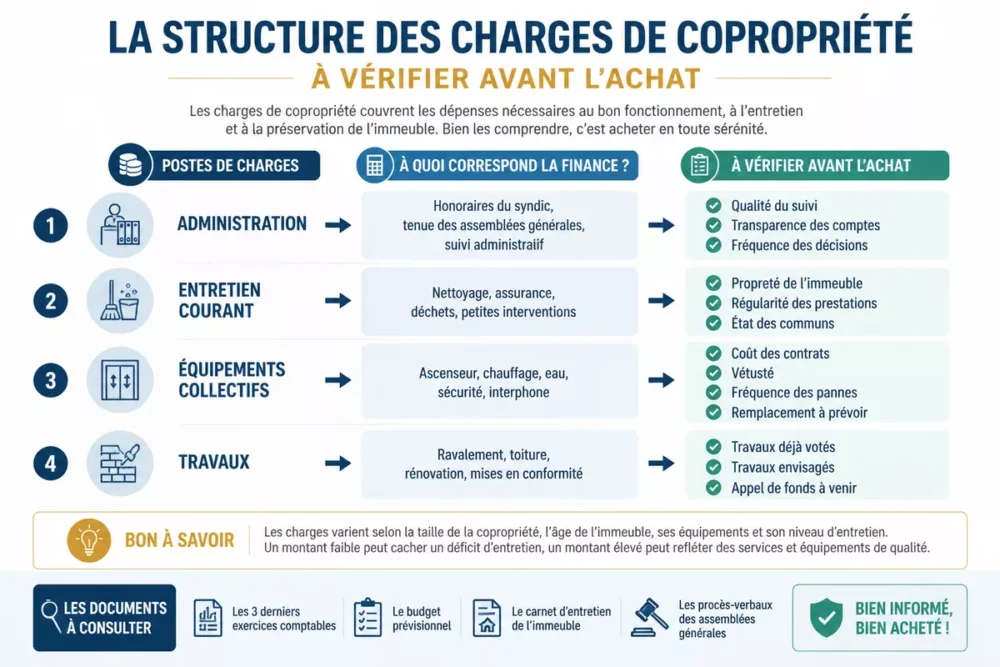
Before buying, you need to know where the money goes. The main items almost always appear, even if their weight varies depending on the building, its age, and its equipment.
- Administration: property manager’s fees, holding general meetings, administrative follow-up.
- Maintenance: cleaning of common areas, garbage removal, minor repairs, insurance, sometimes facade renovation.
- Collective equipment: collective heating, water, elevator, intercom, TV antenna, security.
- Works: facade renovation, roofing, energy renovation, compliance upgrades, major maintenance voted in assembly.
This reading grid is more useful than a simple “low fees / high fees” approach. A condominium may show moderate fees because some works have been postponed, or conversely high fees because the building is well maintained and equipped with costly but comfortable facilities.
| Item | What it finances | What the buyer should check |
|---|---|---|
| Administration | Property manager, management, general meetings | Quality of follow-up, transparency of accounts, frequency of decisions |
| Routine maintenance | Cleaning, insurance, waste, minor repairs | Cleanliness of the building, regularity of services, condition of common areas |
| Collective equipment | Elevator, heating, water, security, intercom | Contract costs, obsolescence, frequency of breakdowns, replacement needed |
| Works | Facade restoration, roofing, renovation, compliance upgrades | Works already approved, planned works, upcoming calls for funds |
Low charges are not always good news: they can mask postponed works or minimal maintenance.
How to know if the announced amount is consistent before buying?
The right approach is to compare the condominium fees with the technical reality of the building, not with a vague average. An elevator, collective heating, a caretaker, green spaces, or an old building do not generate the same budget as a small recent residence. Consistency is found in the items, the differences, and the history, not in a single amount.
For a first estimate, look at four indicators: the size of the condominium, the presence of collective equipment, the age of the building, and the works already announced. This method is similar to the one applied to other complex properties, like a flat-roof house: the visible cost matters less than the future usage and maintenance expenses.
To visualize the method before a visit or reading documents, a short video can help place the figures in context.
Signals to compare before signing
- The annual amount of charges and its evolution over several years.
- The share of equipment: elevator, heating, water, security, ventilation.
- The works already approved or regularly postponed.
- The level of service: caretaker, cleaning, landscaping maintenance, technical contracts.
- The stability of the condominium: unpaid fees, disputes, frequent changes of property manager.
| Observed signal | Possible interpretation | Action to take |
|---|---|---|
| Very low charges | The building may be under-maintained or major items are deferred | Check recent works and upcoming votes in the general meeting |
| Charges continuously increasing | Rising contract costs, service inflation, or aging building | Request the history of calls for funds and upcoming estimates |
| High weight of elevator or heating | Costly equipment, often sensitive to breakdowns and upgrades | Check the age of installations and maintenance contracts |
| Repeated works | Building requires more maintenance than announced or decisions postponed too long | Read the general meeting minutes over several years |
The real issue is not to pay less at all costs, but to know what is paid for, why, and how often.
Why do two similar apartments not have the same charges?
Two properties with the same area can show very different condominium fees. The reason often comes from the condominium regulations, the shares, the presence of collective equipment, and associated services. An apartment on the top floor with an elevator does not have the same cost structure as a ground floor in a small condominium without services.
Differences also depend on how the building is managed. A responsive property manager, renegotiated contracts, recent equipment, or a clear work schedule can stabilize the budget. Conversely, a building where everything has been deferred often ends up concentrating expenses at the same time. This is when condominium fees become a warning signal, not just an expense line.

Before comparing two listings, take a look at the financial “profile” of the property: collective or individual heating, presence of an elevator, number of units, common areas, volunteer or professional management, and the level of maintenance observable on site. An attractive purchase price can become less interesting if future charges are heavy or unstable.
The factors that really affect the budget
- The size of the co-ownership: the more units there are, the more some costs can be spread out, but management often becomes more complex.
- The age: the older a building gets, the more work and maintenance costs weigh in.
- Common equipment: elevator, collective heating, ventilation, automatic gate, green spaces.
- The level of service: security, daily cleaning, enhanced technical maintenance.
- Past decisions: postponed work, contracts not renegotiated, unpaid fees, changes in management.
What questions to ask the seller or the management?
The best protection before buying is concrete documents and questions. If the seller or the management cannot explain the evolution of co-ownership charges, you are buying blindly. Useful answers concern recurring expenses, future work, the status of contracts, and decisions already voted on.
A serious file should allow understanding the situation without guesswork. Ask for documents, not just promises, and compare answers over several years rather than a single fiscal year.
Checklist to request before signing
- The last three general assembly minutes.
- The most recently voted budget forecast.
- The details of calls for funds and their evolution.
- The record of voted work, completed or postponed.
- The co-ownership regulations and the cost-sharing key.
- Main contracts: elevator, heating, cleaning, insurance.
Truly useful questions
- What explains the recent increase or decrease in co-ownership charges?
- What work has been discussed, voted on, or postponed?
- Which contracts are expiring and can be renegotiated?
- Are there unpaid fees or recurring tensions between co-owners?
- Does the announced amount include exceptional expenses or only the current ones?
If I buy to rent, which charges should I distinguish?
When the property is intended for rental, the perspective changes again. You must separate what falls under the owner and what can, depending on the applicable legal framework, be recovered from the tenant. The issue is simple: a high co-ownership charge is not necessarily a problem if it is partially recoverable, but it remains a holding cost to be considered.
The ANIL reminds that there are recoverable expenses and others that are not, with rules for justification and adjustment. Before buying to rent, you must therefore think in terms of net real cost, not just the displayed amount.
| Type of charge | Reading for the owner | Point of vigilance |
|---|---|---|
| General charges | Often borne by all co-owners | Check the cost-sharing key of the unit |
| Charges related to collective services | Can weigh heavily if heating or water are shared | Control the impact on rental profitability |
| Recoverable charges | Can, depending on the legal framework, be re-invoiced to the tenant | Require clear supporting documents and a good breakdown |
| Work and major maintenance | Generally remain the owner’s responsibility | Anticipate them in the financing plan |
This distinction is crucial to avoid misleading profitability. An apartment may seem well located and properly rented, but become fragile if the condominium fees increase faster than the rents or if several works are concentrated in the first years of ownership.
Can high charges be contested or anticipated?
Condominium charges can be contested, but rarely based on a general impression. There must be a specific point to verify: allocation error, non-compliant expense, incorrect title, poorly allocated charge, or questionable decision. In practice, anticipation remains the most important, as a good review before purchase avoids most unpleasant surprises.
If you discover a poorly managed budget afterward, the issue is not only legal. You also need to assess the concrete effect on your situation: upcoming calls for funds, major works, lasting increase in charges, or a simple one-time adjustment. The file must be compared to the reality of the building, not to a commercial promise.
The most expensive condominium is not necessarily the least healthy; the cheapest condominium is not necessarily the most prudent.
What to look at first
- The allocation basis: general charges are not allocated randomly, they follow the condominium regulations and the relative value of the units.
- The nature of the expense: administration, maintenance, collective services, works.
- The repetition of anomalies: an isolated error does not carry the same weight as a structural problem.
- The trend over three years: this is often more revealing than a single fiscal year.
How to reduce risk without underestimating the building?
Reducing risk does not mean looking for the cheapest condominium, but the most transparent. A good analysis before purchase must include maintenance, contracts, charge allocation, and the work schedule. This also allows negotiating the purchase price with concrete arguments, instead of settling for a general impression.

In practice, it is better to buy a property whose charges are clear and assumed than a “cheap” property whose future expenses are unclear. The difference is rarely visible in the listing, but it almost always appears in the condominium documents.
Good habits before buying
- Compare charges with those of similarly configured buildings.
- Reread the general meeting minutes to spot recurring works.
- Check costly equipment: elevator, heating, ventilation, security.
- Observe the actual condition of common areas during the visit.
- Ask if exceptional calls for funds are expected.
- Do not confuse “reasonable charges” with “simply underestimated charges.”
Key takeaways
- 🔸 Condominium charges tell the health of a building as much as its comfort.
- 🔸 A low amount may hide deferred works or insufficient maintenance.
- 🔸 The allocation of charges depends on the condominium regulations and common equipment.
- 🔸 Before buying, always ask for the general meetings, the provisional budget, and calls for funds.
- 🔸 For a rental purchase, distinguish owner costs, recoverable charges, and major works.
Ultimately, understanding condominium charges before buying is avoiding an evaluation error. The right property is not only the one that costs the least at entry; it is the one whose future expenses are identifiable, plausible, and compatible with your budget.
FAQ
Which condominium fees should be checked first before buying?
Start with fees related to heavy equipment, heating, the elevator, and already approved works. These are the items that can tip the budget after purchase. Also look at the trend over several years, not just the most recent call for funds.
Are low condominium fees always good news?
No. Low fees can indicate a poorly maintained building, poorly managed contracts, or deferred maintenance. They can be attractive if the building is simple and well managed, but they should always be considered in relation to the actual condition of the building.
Can you request the minutes of the general assembly before buying?
Yes, and it is actually one of the most useful checks. The minutes reveal approved works, potential tensions, unpaid fees, and decisions that may affect future condominium fees.
Who pays the fees if I buy to rent out?
The owner bears the condominium fees that are their responsibility, while only a portion may possibly be recovered from the tenant according to the applicable legal framework. Therefore, it is important to distinguish recoverable fees from expenses that remain permanently your responsibility.
How can you tell if the announced amount is reasonable?
Compare the fee structure with the characteristics of the building: presence of an elevator, collective heating, caretaker, age, upcoming works. A good amount is above all an amount that is explainable, stable, and consistent with the level of service offered.
What should you do if the fees seem abnormally high?
Request detailed documents, check the breakdown, and identify the item that weighs the most. If the fee results from costly works or equipment, this information is important for your purchase decision. If it comes from an allocation error, it deserves further investigation.