Choosing a vacation rental is not just about comparing pleasant photos or looking for the lowest price. The right accommodation is the one that matches your way of traveling: length of stay, group composition, need for quiet, access to transportation, level of equipment, children’s constraints, pets allowed, actual budget, and safety margin in case of unforeseen events.
The issue is simple: a poorly chosen vacation rental can turn an anticipated stay into a series of tiring compromises. Conversely, accommodation consistent with your plans helps avoid unnecessary trips, hidden fees, disappointments upon arrival, and tensions among travelers. Here is a concrete method to decide more clearly, without being guided solely by reviews or promotions.
Table des matières
In Brief
🏡 A good vacation rental is first chosen according to the actual use of the stay: rest, sightseeing, teleworking, family, hiking, beach, or itinerancy.
📍 Location often matters as much as the lodging: check travel times, shops, parking, transportation, and potential noise.
🔎 Before booking, check the cancellation policies, additional fees, house rules, essential amenities, and the identity of the landlord or platform.
⚖️ For seasonal rentals in France, the concepts of tourist furnished rental, classification, tourist tax, and compliant listing can have practical consequences.
Why Isn’t the Best Accommodation Always the Highest Rated?
The best accommodation is rarely universal: it depends on the planned stay. An isolated house can be perfect for resting but inconvenient for sightseeing without a car. A central apartment may be ideal for a short urban stay but less comfortable with young children. The average rating should therefore be read as a signal, not as a decision.
Vacation rental platforms highlight photos, reviews, and immediate availability. These elements are useful, but they can mask decisive criteria: actual distance to activities, noise, bedding, heating, parking, accessibility, stairs, internet connection quality, or flexibility of arrival. A very attractive listing can be a bad choice if it does not match the travel pace.
A successful vacation rental is not the one that ticks the most boxes, but the one that avoids bad compromises on a daily basis.
This logic applies to all formats: city apartment, villa with pool, rural cottage, bed and breakfast, tourist residence, or campsite. For example, a rural cottage can offer true autonomy and a quiet setting, but it often requires more precise organization for shopping, meals, and transportation.
How to Choose a Vacation Rental According to the Type of Stay?
To choose a vacation rental, start from the actual program before looking at listings. A rest stay requires quiet and comfort on site; a sightseeing stay demands a good location; a family vacation calls for practical amenities; an itinerant trip favors flexibility and access.
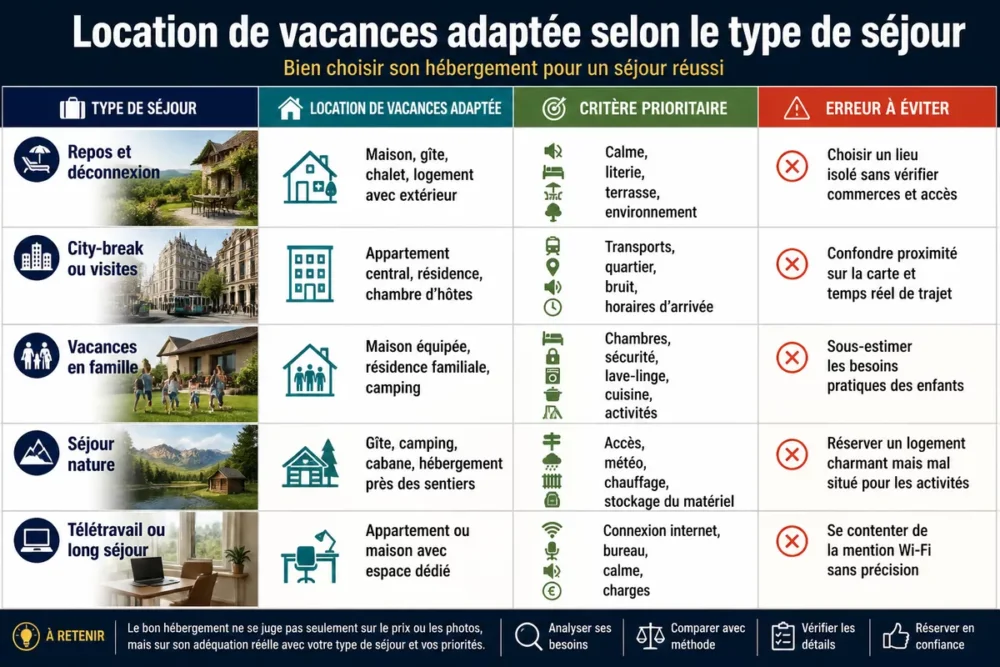
The first mistake is to reason only in terms of surface area or price per night. A more expensive rental but well located can cost less overall if it reduces trips, fuel, parking, or meals eaten out. Conversely, a large house far away can become restrictive if every activity requires an hour’s drive.
| Type of stay | Suitable holiday rental | Priority criterion | Mistake to avoid |
|---|---|---|---|
| Rest and disconnection | House, cottage, chalet, accommodation with outdoor space | Quiet, bedding, terrace, environment | Choosing an isolated place without checking shops and access |
| City-break or sightseeing | Central apartment, residence, bed and breakfast | Transport, neighborhood, noise, arrival times | Confusing proximity on the map with actual travel time |
| Family holidays | Equipped house, family residence, campsite | Rooms, safety, washing machine, kitchen, activities | Underestimating the practical needs of children |
| Nature stay | Cottage, campsite, cabin, accommodation near trails | Access, weather, heating, equipment storage | Booking a charming accommodation but poorly located for activities |
| Remote work or long stay | Apartment or house with dedicated space | Internet connection, desk, quiet, utilities | Settling for the mention “Wi-Fi” without details |
For nature holidays, camping can also be a credible alternative to a detached house, provided the desired level of comfort is checked. A stay like a nature camping in the Jura does not imply the same expectations as an urban apartment: the environment, weather, outdoor activities, and shared facilities become central.
What criteria should you check before booking a holiday rental?
Before booking a holiday rental, check the listing as a practical contract: approximate or exact address, amenities, sleeping arrangements, fees, security deposit, cancellation, cleaning, arrival, departure, pets, parking, and neighborhood rules. The goal is to identify constraints before payment, not upon arrival.
A reliable listing should allow you to understand what is included and what is not. Cleaning fees, linens, tourist tax, energy consumption, or certain services can change the actual cost of the stay. It is therefore useful to compare offers on a total amount, not just on the nightly rate displayed.
- Location: actual distance to the beach, slopes, city center, shops, or transport.
- Sleeping arrangements: number of real beds, sofa bed, room distribution, and privacy.
- Amenities: kitchen, washing machine, heating, air conditioning, Wi-Fi, baby equipment, barbecue, pool.
- Additional fees: cleaning, linens, security deposit, parking, tourist tax, optional services.
- Conditions: cancellation, schedules, house rules, no parties, pets allowed or not.
- Proofs: consistent reviews, many photos, precise description, written exchanges with the landlord.
In France, a holiday rental may fall under the furnished tourist accommodation regime. The Service-Public website reminds that these accommodations correspond to furnished villas, apartments, or studios offered to transient clients who do not establish residence there. Rules may vary depending on the municipality, especially for declaration or registration number: the official page should therefore be checked before renting or listing a property.
The furnished tourist accommodation classification, when it exists, provides a comfort benchmark, but it does not replace careful reading of the listing. Atout France presents this classification as a voluntary process allowing evaluation of the level of equipment and services. For the traveler, it is a useful indicator, to be cross-checked with location, recent reviews, and personal constraints.
How to balance price, location, and comfort?
The right balance consists of calculating the full cost of the stay, not just the price of the holiday rental. A distant accommodation may seem economical but add travel, fuel, parking, lost time, or daily fatigue. Conversely, a central accommodation may justify its price if it truly simplifies the stay.
The question is therefore not “which accommodation is the cheapest?”, but “which accommodation reduces the most burdensome constraints for this specific stay?”. For a family, it might be a fully equipped kitchen and proximity to shops. For a couple on a city break, it might be the neighborhood. For a group of friends, it might be the distribution of bedrooms and noise rules.
The price of a holiday rental should always be read in context: access, additional fees, travel time, and level of autonomy.
A good habit is to draw a small decision tree before opening the platforms. This forces you to prioritize criteria: what is essential, what is desirable, what would be nice but not decisive. This method prevents being seduced by a pool, a view, or decoration if the accommodation fails the main need.

Which holiday rental to choose according to the travelers’ profile?
A holiday rental must be chosen according to the people who will actually live there, not just according to the destination. Children, teenagers, seniors, pets, couples, groups of friends, or remote workers do not have the same needs. Comfort often depends on concrete details: stairs, noise, bathroom, kitchen, outdoor space.
For a family with young children, a very stylish but fragile accommodation can become stressful. For teenagers, access to activities, transport, or Wi-Fi may matter more than a large garden. For seniors, a single-story accommodation, well heated and close to services may be more relevant than an isolated house with a view.
- List the non-negotiable constraints: number of bedrooms, accessibility, pets, parking, quietness, maximum budget.
- Rank the desires: pool, view, terrace, fireplace, decoration, immediate proximity to a tourist site.
- Test a typical day: breakfast, departure, activities, shopping, meals, return, sleep.
- Check bad weather scenarios: indoor space, games, heating, covered activities, distance to shops.
- Reread recent reviews: look for repeated remarks rather than isolated comments.
This approach also applies to camping accommodations, especially in highly touristic regions. A stay in camping in Dordogne, for example, can be excellent for enjoying the river, villages, and outdoor activities, but it requires choosing between animation, quietness, water access, and proximity to sites.

What signals should alert you before paying?
A holiday rental ad must inspire confidence through its coherence. Beware of abnormally low prices, very limited photos, vague descriptions, requests for payment outside the platform, pressing responses, or unclear conditions. Any doubt before payment always deserves further verification.
The DGCCRF more broadly recommends vigilance in holiday transactions, especially against deceptive practices, incomplete information, or disputes related to tourist services. For a traveler, the challenge is not to become a lawyer, but to keep written records, read the conditions, and never pay in a context that seems unusual.
- Ad too vague: few photos, no floor plan, imprecise address, equipment not detailed.
- Inconsistent price: rate much lower than comparable accommodations without clear explanation.
- Risky payment: request for direct transfer without contract, outside the platform or to a different name.
- Commercial pressure: artificial urgency, threat of losing the offer, refusal to answer questions.
- Suspicious reviews: very similar comments, only praise, or complete absence of history.
It is also wise to ask for information not included in the ad: floor, elevator, street noise, type of heating, internet speed, actual walking distance, presence of nearby construction or pool usage conditions. A clear written response protects better than an approximate oral exchange.
How to compare several listings without getting lost?
To compare several vacation rental listings, first limit yourself to three or four serious options. Rate them using the same criteria: total price, location, sleeping arrangements, amenities, conditions, recent reviews, and risks. A short but structured comparison is better than endless browsing through dozens of listings.
The classic trap is opening too many tabs and changing priorities with each appealing accommodation. To avoid this, create a simple grid. It should reveal trade-offs, not just qualities. One rental may be very beautiful but too far away; another less photogenic but more practical for the stay.
| Criterion | Question to ask | Good sign | Point of caution |
|---|---|---|---|
| Location | How long to reach the main activities? | Clear access, consistent map, reviews confirming the location | Distance given “as the crow flies” or poorly specified neighborhood |
| Budget | What is the total cost of the stay? | Fees visible before payment | Cleaning, linen, parking or tax added late |
| Comfort | Is the accommodation suitable for a full day on site? | Detailed photos, listed amenities, specified bedding | Careful decoration but practical information missing |
| Reliability | Does the renter respond clearly? | Written exchanges, consistent conditions, recent reviews | Evasive answers or unusual payment requests |
This method is especially useful when the destination itself is torn between several types of stays. Choosing a city, a seaside resort, or a countryside village sometimes involves the same trade-offs detailed in this guide on choosing between a medium-sized city and a metropolis: budget, travel, services, and daily rhythm matter as much as the image of the destination.
Should you favor a platform, a private individual, or a certified accommodation?
There is no single ideal channel for booking a vacation rental. A platform often provides a payment framework and reviews; a private individual can offer direct contact; a label or rating gives benchmarks; a local agency can secure the welcome. The right choice depends on the level of guarantee sought.
Major vacation rental sites dominate results because they facilitate the search: filters, availability, payment, messaging, reviews, and quick comparison. Their limitation is that the abundance of listings can make the decision confusing. Rentals between private individuals can be interesting, but they require more checks on the contract, payment, and actual condition of the accommodation.
Certified or rated accommodations do not guarantee a perfect stay, but they add an external benchmark. This is useful when booking far away, long in advance, or with travelers who have specific needs. The rating, labels, reviews, and exchanges with the renter should be read together, never separately.
Which sources to consult before an important booking?
For an engaging vacation rental, especially during peak season or for a long stay, a few reliable sources help reduce risks. Platforms provide a commercial perspective; official sites offer a framework on rules, classification, or rights. Cross-referencing both avoids taking the listing as the sole truth.
- Service-Public: general information on furnished tourist accommodations and certain applicable obligations.
- Atout France: benchmarks on the classification of furnished tourist accommodations.
- DGCCRF: consumer vigilance information, disputes, and commercial practices.
- Municipality or tourist office website: tourist tax, local regulations, access, parking, and events.
- Official conditions of the platform used: cancellation, payment, security deposit, and procedures in case of dispute.
For a stay abroad, the logic remains the same, but you must add local rules, insurance, payment methods, and entry conditions into the country. A distant trip, such as vacations in Tanzania, for example, requires considering accommodation along with transportation, activities, season, and formalities, not just as a simple place to sleep.
Key Takeaways
- 🏡 A vacation rental should be chosen based on the actual stay, not just the photos.
- 📍 Location can cost or save time, energy, and additional expenses.
- 🔎 Conditions, amenities, and fees must be verified before any payment.
- ⚖️ Official sources help understand classification, local rules, and possible recourse.
- 🧭 A simple comparison grid prevents impulsive choices and unpleasant surprises.
FAQ
When should you book a vacation rental?
It is better to book early for highly demanded periods, family destinations, and rare accommodations. Conversely, a late booking may be suitable if you are flexible on destination, type of accommodation, and dates.

How to know if a vacation rental listing is reliable?
A reliable listing features consistent photos, a precise description, clear conditions, and recent reviews. You should also verify fees, ask written questions, and avoid payments outside secure frameworks.
What is the difference between a gîte, a furnished tourist accommodation, and a bed and breakfast?
A furnished tourist accommodation is an equipped lodging rented to transient customers. A gîte is often a form of furnished accommodation intended for tourism, while a bed and breakfast generally involves hosting by the owner with associated services.
Should you choose a vacation rental with a classification?
Classification can be a good indicator of comfort and equipment, but it is not enough. It should be cross-checked with location, recent reviews, photos, booking conditions, and your specific needs.
How to avoid hidden fees in a vacation rental?
Always compare the total cost before payment: cleaning, linens, security deposit, tourist tax, parking, heating, or optional services. If a cost is unclear, request written confirmation before booking.