
The envelope method applied to the family budget is making a strong comeback for a simple reason: many households don’t necessarily lack good will, but rather visibility. Between groceries, children, leisure, fuel, online shopping, and small automatic withdrawals that slip by unnoticed, the bank account can quickly become unreadable. This method puts a concrete rule back at the center of the game: every euro has a destination, and every category has a limit.
Its appeal is not just about the “paper envelopes” aspect or the famous cash stuffing popularized on social media. What matters is the logic: breaking down the monthly budget into spending categories, tracking what is actually left available, and adjusting before the end of the month turns into a balancing act. Here, we will see how to use it in a real household, with its unforeseen events, card payments, trade-offs, and sometimes, good old mental fatigue.
Table des matières
In Brief
💶 The envelope method consists of allocating a specific amount to each spending category: food, transport, leisure, health, clothing, gifts, or savings. When the envelope is empty, you stop spending in that category until the next cycle.
📱 It works today just as well with physical envelopes as with bank sub-accounts or a budget app. Digital tools simplify tracking but do not replace the basic rule: set a ceiling and check it regularly.
👨👩👧 For a family budget, the method is especially useful for variable expenses: groceries, outings, children, fuel, clothing, gifts. Fixed charges like rent, insurance, or loans usually remain separate, as they are already deducted automatically.
⚠️ The classic trap? Trying to control everything from the first month. It’s better to start with expenses from the last three months, set realistic amounts, then adjust gradually. Joking aside, a budget that is too perfect often ends up abandoned.
Why Does the Envelope Method Still Appeal for Managing a Family Budget?
The envelope method appeals because it makes the family budget visible and concrete. It transforms scattered expenses into capped categories, which helps make trade-offs before buying. Its effectiveness mainly comes from friction: you see what’s left, so you spend less automatically.
Overall, the family budget envelope method addresses a very current problem: expenses have become fluid, fast, almost invisible. A contactless payment here, an online order there, a forgotten subscription, and the “remaining to live on” becomes more of a feeling than a number. Envelopes bring concreteness back to management that has become too abstract.

The principle is deliberately simple: define an amount for each spending category, then use only that sum during the planned period. Fixed charges — rent, insurance, electricity, loans, phone plans — are generally excluded because they are already scheduled. The method mainly targets variable expenses, those that slip away quietly.
This success is also due to a very powerful psychological mechanism: the limit becomes tangible. When a “leisure” envelope contains €80 for the month, each outing has a visible cost. In other words, the method doesn’t just say “spend less,” it forces you to choose. And in a household, it’s often this ability to make trade-offs that is most lacking.
A family budget doesn’t become stronger because it is detailed down to the last cent, but because it remains readable at the moment of decision.
Good to know: the portal Mes Questions d’Argent explains the envelope budgeting method starting from the monthly budget and the remaining living expenses. This approach is interesting because it avoids reducing the method to a simple binder trick: the key is to know what a household can actually spend after its obligations.
In practice, it is observed that the families who best maintain the method are not those who create fifteen envelopes from the start. They often begin with four or five very concrete categories: groceries, fuel, children, leisure, and unforeseen expenses. Then they refine after two or three months, when habits become more visible.
What digital tools really change
Cash stuffing has brought paper envelopes back into the spotlight, but the daily reality is less glamorous than a well-edited video. Many families pay by card, order online, use direct debits, and sometimes share expenses across two accounts. That is why virtual envelopes can be an excellent adaptation, provided the system is not turned into a complicated mess.
Digital technology mainly changes three things: it facilitates the separation of amounts, automates certain transfers, and allows tracking expenses without manually entering each receipt. Bank sub-accounts, joint accounts, cards with systematic authorization, or budgeting apps replicate the same logic: one envelope = one limit = one decision.
- Bank sub-accounts: useful for separating groceries, vacations, savings, or children’s expenses.
- Budgeting apps: practical for categorizing payments and visualizing trends.
- Shared spreadsheet: less automatic, but very clear for a couple who wants to keep control.
- Cash: effective for impulsive expenses, but less suited for online purchases.
It is always advisable to schedule transfers just after income arrival. For example, if the salary is paid on the 28th or the 1st, one can automatically fund the “groceries,” “transport,” “savings,” and “leisure” envelopes. The idea is not to lock everything down but to give shape to the month before expenses start eating into it.
Still, be careful about confidentiality. A budgeting app can be very useful, but it requires checking how data is collected, stored, and used. For this point, the advice from the CNIL on controlling personal data remains a good reflex before connecting a service to your financial habits.
From cash to virtual envelopes
Physical envelopes remain very tangible: you see the money decrease, you better feel the expense, and you more easily avoid impulsive purchases. But they also have their limits. You have to withdraw money, store it, manage receipts, and some payments — canteen, drive-through, fuel, subscriptions, e-commerce — are not naturally settled in cash.
Virtual envelopes solve this problem by keeping the structure without imposing the paper format. A household can create a sub-account “groceries,” another “vacations,” another “unforeseen,” then check balances as if looking at transparent envelopes. Cherry on top: some tools allow automatic categorization of payments, which reduces mental load.
Automate without losing control
Automation is useful as long as it serves decision-making. If the tool classifies everything, but no one looks at the balances, the method loses its meaning. In practice, a short weekly check-in is often enough: you verify the used envelopes, spot categories under pressure, and decide if a reallocation is necessary.
A family shares that the real breakthrough was not switching to an app, but setting a ten-minute appointment every Sunday evening. The numbers were nothing spectacular, but the ritual changed behavior: fewer “random” expenses, fewer unexpected overdrafts, and above all fewer vague discussions about “where the money went.”
How to implement the envelope method in a family budget?
To implement the envelope method, start by listing income and expenses over three months, separate fixed charges and variable expenses, create a few simple categories, then assign a realistic amount to each. Next, track the balances each week and adjust for the following month.
The best way to start is not to look for the perfect budget, but to start from reality. Review your statements from the last three months, note recurring expenses, identify variable items, and calculate an average. This work may seem a bit academic, but it avoids a common mistake: setting €350 for groceries when the household has been spending around €520 for six months.
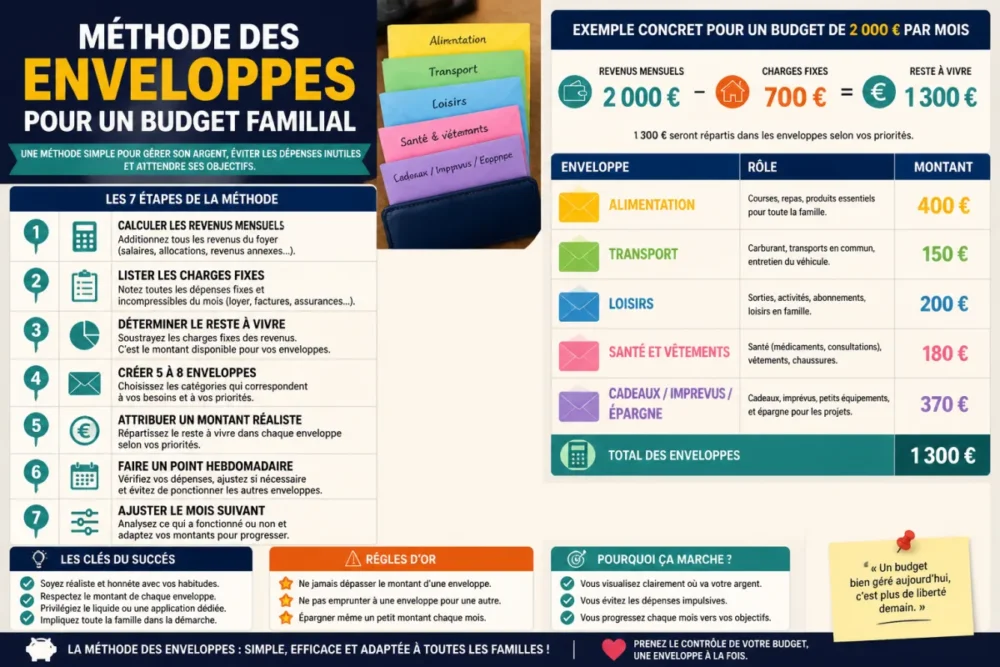
To summarize, fixed charges should be treated separately. They help to know the disposable income, but they are not necessarily put into envelopes. The method becomes really interesting once applied to the items that vary: food, transport, leisure, clothing, gifts, non-reimbursed health expenses, children’s outings, pets, vacations, small household equipment.
- Calculate monthly income: salaries, benefits, pensions, additional income.
- List fixed charges: housing, insurance, energy, loans, phone, essential subscriptions.
- Determine disposable income: income minus fixed charges and priority savings.
- Create 5 to 8 envelopes maximum at the start to avoid complexity.
- Assign an amount to each envelope based on observed actual expenses.
- Make a weekly check-in to avoid unpleasant surprises at the end of the month.
- Adjust the following month without guilt: a family budget is adjusted, not guessed.
Example of monthly allocation on €2,000
Here is a numerical example, to be taken as an educational model and not as a standard. A household with €2,000 monthly income could isolate €700 of fixed charges, then distribute the rest among several envelopes. The goal is not to copy these amounts, but to understand the logic of division.
| Category | Monthly amount | Role in the family budget |
|---|---|---|
| Fixed charges | €700 | Rent, insurance, energy, plans, loan |
| Food | €400 | Groceries, everyday products, meals at home |
| Transport | €150 | Fuel, tickets, parking, short trips |
| Leisure | €200 | Outings, restaurants, family activities |
| Health and clothing | €180 | Occasional expenses, pharmacy, shoes, clothes |
| Gifts, unforeseen expenses and savings | €370 | Birthdays, back to school, vet, emergency savings |
In this example, the “savings” envelope is not what remains at the end. It is planned from the start. This is an important nuance: if savings come after all variable expenses, they risk being swallowed up by small emergencies and comfort purchases. Provided the amount is realistic, considering it as a full envelope really changes the game.
Planning for irregular expenses
Irregular expenses are often the big forgotten items in the family budget: gifts, back to school, vehicle inspection, vet, appliance replacement, vacations, occasional medical costs. They are not unforeseen because they come “by surprise,” but because they have not been monthly planned.
A good tip is to create an “events” or “annual expenses” envelope. If back to school often costs a lot, it’s better to set aside a little each month rather than absorb the entire expense in September. The same logic applies for Christmas, birthdays, or vacations: the calendar becomes a budgeting tool, not just a reminder of dates.
Paper or digital envelope method: how to choose?
Choose paper envelopes if you need to see the money physically to limit impulsive spending. Prefer digital if your payments are mostly by card, if the budget is shared between two people, or if you want to automate transfers and tracking.
There is no “superior” version of the envelope method. There is a version compatible with your lifestyle. A person who shops with cash and wants to curb impulsive purchases may love paper envelopes. A couple who pays everything by card and shares children’s expenses will often find digital more seamless.
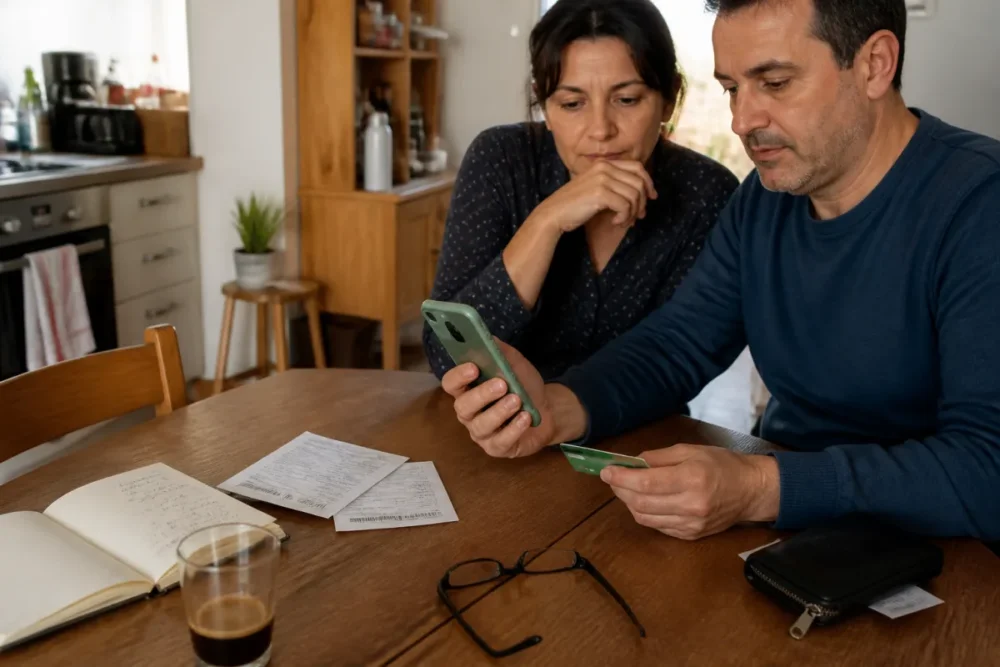
In practice, many households adopt a hybrid solution. For example: virtual envelopes for major categories, cash for risky expenses like outings or small treats, and an automated savings envelope. This is often more sustainable than a 100% paper or 100% app system.
| Solution | Strengths | Limitations | Suitable profile |
|---|---|---|---|
| Physical envelopes | Very visual, curbs impulsive purchases | Not practical for online payments | People who spend too easily by card |
| Bank sub-accounts | Automatable, clear, compatible with card | Depend on options offered by the bank | Couples, families, shared budgets |
| Budget app | Categorization, charts, quick tracking | Risk of complexity and personal data issues | Households comfortable with digital tools |
| Simple spreadsheet | Flexible, transparent, without opaque automation | Requires regular entry | People who want to understand everything themselves |
The right criterion for choice is therefore not modernity, but sustainability over time. If an app gives you beautiful charts but you never open it, it is not very useful. Conversely, an ugly paper envelope but checked every week can be remarkably effective.
The best family budget tool is the one that creates a simple decision before spending, not a complicated analysis afterward.
Errors that cause a family budget to fail
The envelope method rarely fails because it is bad. It fails rather when it becomes too strict, too detailed, or too far from real life. A household with children, commutes, rushed meals, birthdays, and unforeseen events does not operate like a neatly organized Excel sheet. You must therefore leave some margin, otherwise the system breaks down at the first complicated Wednesday.
- Creating too many envelopes: twenty categories give an impression of control, but they quickly become unmanageable.
- Forgetting small repeated expenses: bakery, coffees, deliveries, children’s extras, parking.
- Underestimating variable expenses: especially food, which fluctuates with holidays, guests, or prices.
- Not planning for the unexpected: without a dedicated envelope, each incident empties another category.
- Confusing budget with deprivation: a sustainable budget must include pleasure, even modest.
Another common mistake: moving money between envelopes without ever analyzing why. Reallocating is not forbidden, on the contrary. But if the “groceries” envelope is empty by the 18th of each month, the problem may not be a lack of discipline: the amount may be underestimated, or purchasing habits need to be reviewed.
It is also important to be careful with more fragile situations. If overdrafts accumulate, if revolving credits finance current expenses, or if essential bills are no longer paid, the envelope method can help clarify things, but it does not replace support. The Bank of France presents the procedures related to over-indebtedness for cases where the budget is no longer sufficient to absorb debts.
Adapting the method to irregular incomes and unforeseen events
The envelope method is not reserved for fixed salaries. It can even be very useful for freelancers, temporary workers, seasonal workers, or households with partly variable income. In this case, it is necessary to avoid building the budget on the “good month.” The cautious basis is to start from a low average income, then allocate surpluses to emergency savings, possible delays, or annual expenses.
For irregular incomes, the rule can be formulated as follows: first finance vital expenses, then priority variable envelopes, then comfort. This hierarchy avoids consuming exceptional income as if it were going to repeat every month. This means that favorable months serve to smooth out weak months.
- Level 1: housing, energy, essential insurances, food, necessary transport.
- Level 2: health, children, debts to regularize, emergency savings.
- Level 3: leisure, outings, non-urgent clothing, comfort projects.
In practice, inhabitants of a household with variable income benefit from keeping a “buffer” envelope. It should not be used for just anything, but to absorb discrepancies: a higher bill, an extra fill-up, a repair. In other words, it protects the other envelopes and prevents the domino effect.
The right method is the one the household can maintain
The strength of the envelope method is not to promise a perfect family budget. Rather, it provides a visible, debatable, and adjustable framework. That is already huge. In a couple or family, it allows moving from vague discussions — “we spend too much” — to concrete decisions: “we put €400 on groceries, €150 on transport, and we check on Friday where we stand.”
Digital tools do not replace this discipline, but they can make it easier. Sub-accounts avoid mixing, apps provide a quick overview, automatic transfers protect savings, and physical envelopes retain their educational power. The right system is often hybrid: a simple logic, some useful automations, and a regular appointment to keep control.
Key takeaways
- 💡 The envelope method makes the family budget visible before spending.
- 📌 Fixed expenses serve for calculation, but envelopes mainly target variable expenses.
- 📱 Sub-accounts and apps modernize the method without removing the necessary discipline.
- 🧾 A good budget starts with the actual expenses of the last three months.
- 🛟 An unforeseen expenses envelope protects the rest of the budget from the domino effect.
FAQ
How many envelopes should be created to start?
To start, 5 to 8 envelopes are more than enough. The most useful categories are often food, transport, children, leisure, health, gifts/unexpected expenses, and savings. Beyond that, tracking can become too heavy, especially in an already busy family budget.
Does the envelope method work without using cash?
Yes, provided the principle of a ceiling per category is maintained. Envelopes can be replaced by bank sub-accounts, a spreadsheet, or a budgeting app. The essential point remains the same: knowing how much is left in each category before spending.
What to do if an envelope is empty before the end of the month?
The classic rule is to stop spending in that category until the next month. In real life, you can reallocate from a less priority envelope, but you must note why. If the problem recurs every month, the planned amount is probably unrealistic.
How to manage children’s expenses with this method?
It is useful to create a specific envelope for children: school meals, activities, clothing, school outings, birthdays. For big periods like the start of the school year, it is better to spread the expense over several months with an “events” or “annual expenses” envelope.
Is a budgeting app essential?
No, it is not essential. It becomes useful if you pay a lot by card, if you manage the budget as a couple, or if you want to automate the categorization of expenses. But an app that is too complex can be discouraging: a simple tool checked weekly is better.