A balcony vegetable garden is not about miniaturizing a traditional garden: you need to choose crops capable of producing in little soil, sometimes with imperfect exposure, more frequent watering, and limited containers. Success depends less on the total area than on three decisions: selecting the right plants, adapting the pot depth, and avoiding mistakes that quickly tire the crops.
The challenge is therefore simple: to transform a few square meters, or even a well-exposed railing, into a realistic edible space. Competing advice often emphasizes soil, light, growing clumps, watering, easy vegetables, and herbs; this is a good base but insufficient to choose what to plant. This article goes further by linking each crop to your exposure, available space, and maintenance level.
Table des matières
In brief
🌱 For a beginner balcony vegetable garden, the best crops are herbs, cut-and-come-again lettuces, radishes, strawberries, and cherry tomatoes if the balcony receives enough sun.
☀️ The decisive rule is not just the surface area: exposure matters more. A very sunny balcony can accommodate tomatoes, peppers, and strawberries; a partially shaded balcony does better with mint, parsley, lettuces, arugula, and spinach.
🪴 The container makes the difference: a large well-drained box is better than an accumulation of small pots that dry out too quickly. The soil depth must correspond to the roots: shallow for radishes and herbs, deeper for tomatoes and fruit vegetables.
💧 The most common mistake is underestimating watering in pots. On a balcony, the soil dries faster than in open ground, especially with wind, warm walls, and small containers.
Why does a balcony vegetable garden require choosing crops differently?
A balcony vegetable garden forces you to think in terms of combined constraints: reduced soil volume, rapid evaporation, maximum balcony load, water access, wind, heat reflected by walls, and sometimes lack of direct sunlight. A crop easy to grow in the garden can become complicated in a pot if it requires many nutrients, deep rooting, or stable moisture.
This is precisely what makes the subject interesting: growing on a balcony is not a degraded version of a vegetable garden, but a different logic. The goal is not necessarily to produce large volumes, but to obtain regular, visible, and useful harvests daily. A few basil leaves, a handful of cherry tomatoes, quick radishes, or strawberries in a planter can bring more satisfaction than an overly ambitious plant that languishes all summer.
The true success of a balcony vegetable garden is not measured by the number of plants installed, but by the number of plants adapted to your exposure and containers.
General articles, like the one from Urban Cuisine dedicated to balcony vegetable gardens dated January 15, 2025, rightly remind us that a small balcony can suffice and that choices of soil, light, growing clumps, and watering are central. The limitation of this approach is that it often leaves the reader with a practical question: which crops to prioritize when space is really lacking?
Which crops to choose for a very sunny balcony vegetable garden?
On a balcony receiving several hours of direct sunlight, favor light-loving but compact crops: cherry tomatoes, strawberry plants, basil, sweet peppers, dwarf bell peppers, and some compact zucchinis if you have a large planter. The idea is not to try everything, but to reserve the best exposure for the plants that really depend on it.
Cherry tomatoes are often the symbol of balcony vegetable gardens, but they are not always the easiest. They require a stable pot, a stake, regular watering, and rich soil. However, they make very good use of a south or southwest-facing balcony, especially if you choose a compact variety rather than an overly vigorous plant.
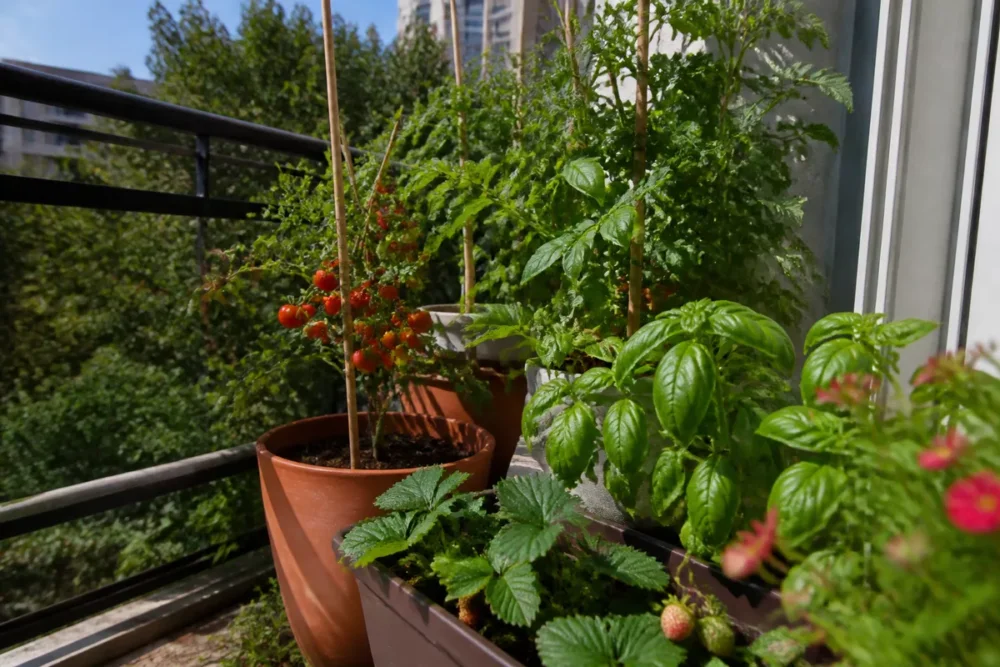
Basil, strawberry plants, and sweet peppers are often more rewarding for a first attempt. Basil is harvested leaf by leaf, strawberry plants do well in window boxes or hanging baskets, and compact peppers tolerate container growing better than many large fruit vegetables. To go further in arranging a small outdoor space, the principles of stability and drainage align with those used to create a sustainable space, even if the scale is different.

What to plant on a partially shaded or less exposed balcony?
On a partially shaded balcony, the most reliable crops are leafy vegetables and tolerant herbs: cut-and-come-again lettuces, arugula, spinach, parsley, chives, mint, coriander, and radishes. They produce fewer fruits but require less direct sunlight than tomatoes, peppers, or eggplants.
An east-facing, northeast-facing, or building-shaded balcony can still accommodate a useful vegetable garden. You just have to give up the idea that all vegetable plants are equal. Leafy vegetables, for example, are interesting because they are harvested progressively: you cut a few leaves, let them regrow, then repeat. This approach suits small spaces very well.
Radishes are also suitable for shallow window boxes and impatient gardeners. Their short cycle allows you to quickly understand if the balcony receives enough light and if watering is well managed. If the leaves stretch toward the light, if the roots remain thin, or if the soil dries out too quickly, the radish becomes a useful indicator before starting more demanding crops.

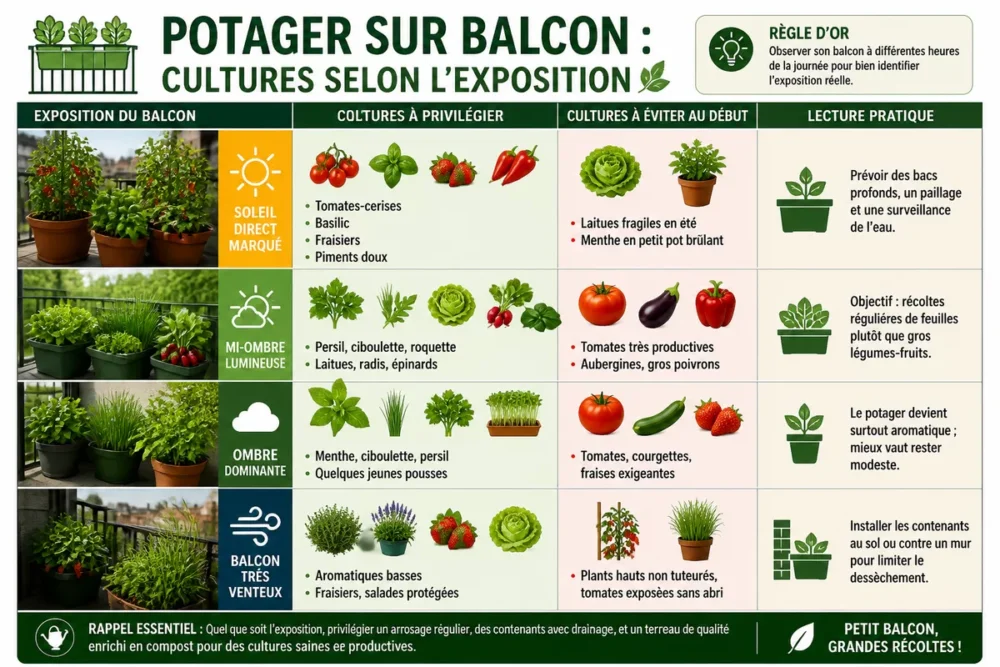
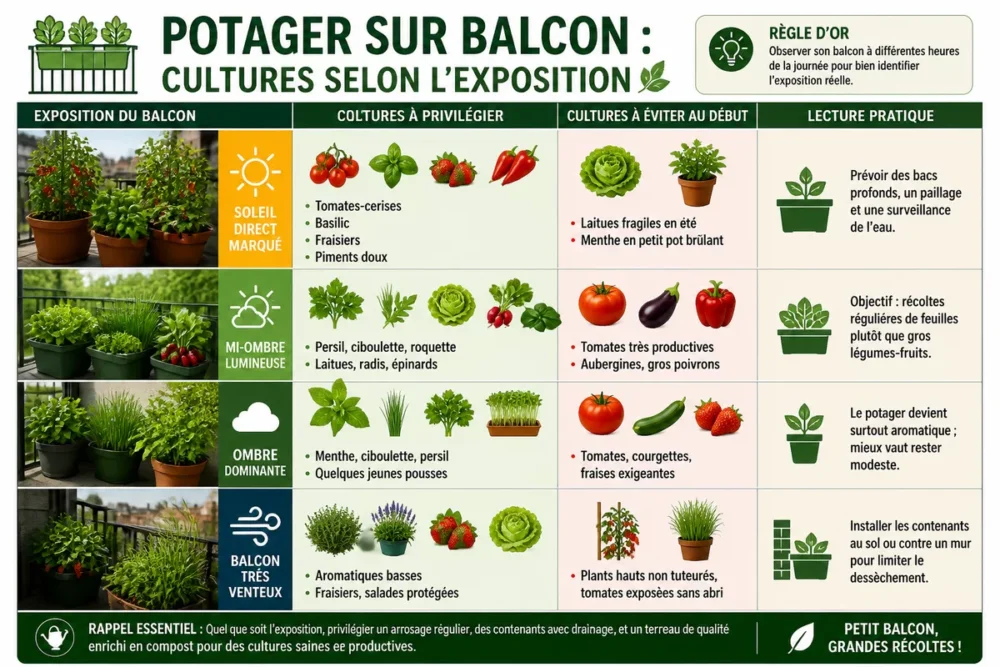
| Balcony Exposure | Crops to Favor | Crops to Avoid at First | Practical Reading |
|---|---|---|---|
| Strong direct sun | Cherry tomatoes, basil, strawberry plants, sweet peppers | Delicate lettuces in summer, mint in a small burning pot | Plan for deep containers, mulching, and water monitoring. |
| Bright partial shade | Parsley, chives, arugula, lettuces, radishes, spinach | Highly productive tomatoes, eggplants, large peppers | Goal: regular leaf harvests rather than large vegetable-fruits. |
| Dominant shade | Mint, chives, parsley, some young shoots | Tomatoes, zucchinis, demanding strawberries | The garden becomes mainly aromatic; better to keep it modest. |
| Very windy balcony | Low aromatics, strawberry plants, protected salads | Tall plants without stakes, exposed tomatoes without shelter | Place containers on the ground or against a wall to limit drying out. |
How much space is really needed for a balcony vegetable garden?
It requires less surface area than one might imagine, but more soil volume than expected. A railing can suffice for aromatic herbs, while a deep container is preferable for tomatoes, strawberries, or vegetable-fruits. The right calculation is to start from the available containers, then choose compatible crops.
A balcony vegetable garden often fails due to over-enthusiasm: too many small pots, too many different species, too little depth, and no space to move around. Yet a balcony must remain a usable place. You need to be able to water without spilling, open a window, move a pot, check the leaves, and avoid water stagnating against the facade or flowing to neighbors.
Here is a simple grid to size your mini-garden without overcrowding the space:
- Edge or railing: compact aromatics, young shoots, trailing strawberries if the planters are well secured.
- Small narrow balcony: rectangular planters, grouped tall pots, sturdy shelf if exposure allows.
- Medium balcony: one large main container for tomatoes or strawberries, complemented by two or three aromatic pots.
- Urban terrace: raised vegetable beds, grow bags, combination of leafy vegetables, aromatics, and vegetable-fruits.
Before installing several heavy containers, check the stability of supports, soil quality, water drainage, and any condominium rules. The same preparation habits as for home improvement apply: observe the support, anticipate moisture, and avoid improvised installations. This preparation logic aligns with that of a durable and well-prepared base, even if the goal here is plant-based.
How to install a balcony vegetable garden step by step?
Start by observing your balcony for a few days: hours of sunlight, windy areas, water points, passage zones, and neighborhood constraints. Only then choose containers, potting soil, plants, and layout. This method avoids buying attractive plants that are unsuitable for your real situation.
A successful installation does not need to be sophisticated. It must above all be clear: the tallest plants at the back or against a wall, aromatics within reach, hungry crops in the deepest containers, and wind-sensitive plants in protected areas. Drainage is essential: a pot without water drainage exposes roots to suffocation, while an overly draining pot requires constant watering.
- Observe the exposure: note the hours of direct sunlight and the areas that remain cool or windy.
- Choose few crops: start with a maximum of three families: herbs, leafy greens, then a pleasure crop.
- Prepare the containers: check the drainage holes, saucers, and stability on the ground or railing.
- Use suitable potting soil: favor a light, fertile substrate capable of retaining water without staying soggy.
- Plant gradually: avoid filling the entire balcony in one day; observe the reaction of the first plants.
- Establish a routine: check moisture, remove damaged leaves, harvest regularly, and adjust watering.
What mistakes prevent a balcony vegetable garden from producing?
The main mistakes are planting too densely, using containers that are too small, watering irregularly, ignoring the wind, and choosing vegetables too demanding for the available exposure. The correction is to simplify: fewer plants, more soil per plant, better drainage, and crops adapted to the actual balcony.
Density is the number one trap. In photos, a balcony filled with plants looks successful; in practice, plants compete for water, light, and nutrients. A tomato stuck in a tiny pot with three herbs at its base will often produce less than a single well-established plant in a comfortable container.
Watering is the other decisive point. In pots, a plant cannot seek moisture deep down. The balcony accentuates this phenomenon: wind, heat from walls, mineral soil, and small containers speed up drying out. Conversely, excess water in a poorly drained container can kill a plant just as surely as forgetting to water.
On a balcony, watering is not a fixed routine: it is a regular observation of the soil, the weather, and the vigor of the leaves.
- Mistake: buying plants first, then thinking about exposure. Correction: observe the light before any purchase.
- Mistake: multiplying small decorative pots. Correction: prefer a few deeper and stable containers.
- Mistake: letting water stagnate in saucers. Correction: empty after watering if the substrate remains soggy.
- Mistake: planting fruit vegetables in the shade. Correction: reserve shade for herbs and leafy vegetables.
- Mistake: forgetting to harvest. Correction: regularly cut basil, arugula, mint, and lettuces to stimulate regrowth.
Which schedule should be followed to harvest without overloading the balcony?
The best schedule is to stagger plantings rather than setting everything up in spring. Sow or plant in small waves: herbs as soon as conditions are mild, radishes and lettuces during temperate periods, tomatoes and basil when the nights are sufficiently mild. This limits losses and spreads out the harvests.
A balcony vegetable garden should remain dynamic. When a radish planter is finished, it can accommodate arugula or a new batch of young shoots. When the basil tires, the space can be freed for a more modest autumn crop. This simple rotation avoids the “frozen balcony” effect, where exhausted plants occupy space without producing.
| Indicative period | Relevant crops | Objective | Point of caution |
|---|---|---|---|
| Early mild season | Parsley, chives, radishes, lettuces | Start fast and tolerant crops | Protect from late cold snaps depending on the region. |
| Late spring | Cherry tomatoes, basil, strawberry plants | Set up heat-loving crops | Do not put out sensitive plants too early during cool nights. |
| Summer | Herbs, tomatoes, strawberries, sweet peppers | Harvest regularly and maintain moisture | Watch for drying out, especially in small containers. |
| Return of mild temperatures | Arugula, spinach, lettuces, parsley | Restart leafy growth after strong heat | Adapt according to exposure and light decrease. |
Which crops should be prioritized if you want a vegetable garden useful for daily use?
For a vegetable garden useful for daily use, first choose plants that you often consume in small quantities: basil, chives, parsley, mint, arugula, cut-and-come-again lettuces, strawberries, and cherry tomatoes. They maximize culinary interest without requiring the space needed for large open-ground vegetables.
The best trade-off is often economic and practical, without necessarily involving significant savings. A planter of parsley or chives avoids buying a whole bunch for just a few sprigs. A pot of mint serves for infusions, salads, and drinks. A few leaves of arugula or basil immediately change a dish. The balcony vegetable garden then becomes an extension of the kitchen rather than a miniature agricultural project.
If you are starting out, a balanced combination might look like this: a deep container for a compact cherry tomato, a planter of cut-and-come-again lettuces, a pot of basil, a pot of parsley, and a hanging strawberry plant. This composition covers enjoyment, frequent use, and learning, without turning the balcony into a difficult-to-maintain space.
This reasoning is especially valid in the city, where outdoor space is rare and precious. When choosing a home or neighborhood, the balcony is often seen as an amenity; it can also become a micro-productive space. People who think about their urban living environment, for example by consulting a guide to choosing the right neighborhood, can include the balcony’s exposure and use in their daily criteria.
Key takeaways
🌿 A balcony vegetable garden succeeds better with few well-chosen crops than with too many crowded plants.
☀️ Exposure determines plantings: sun for tomatoes and strawberries, partial shade for leaves and herbs.
🪴 The volume of soil matters more than the number of pots installed on the balcony.
💧 Watering should follow the weather, wind, and soil condition, not a rigid schedule.
🥗 The most useful crops are often those harvested in small regular quantities.
FAQ
Can you create a vegetable garden on a very small balcony?
Yes, provided you reduce your ambitions. On a very small balcony, start with herbs, radishes, young shoots, or strawberry plants in a planter. Avoid bulky vegetables that require too much soil and complicate movement.
What is the easiest crop to start with?
Herbs like chives, parsley, or mint are often the simplest, especially if the exposure isn’t perfect. Radishes and cut-and-come-again lettuces are also suitable for beginners because they grow quickly and help you learn to manage watering.
Do you need a lot of sun for a balcony vegetable garden?
You mainly need to choose crops according to the available light. Tomatoes, strawberries, basil, and peppers prefer a sunny exposure, while parsley, mint, chives, arugula, and certain lettuces tolerate partial shade better.
How can you prevent pots from drying out too quickly?
Use larger containers, group pots together to limit wind exposure, mulch the soil surface, and check moisture with your finger. Very small decorative pots look nice but often require much more frequent watering.
Can you mix vegetables and herbs in the same container?
Yes, but only if their needs are compatible. A tomato and basil can coexist in a sufficiently large container, while very vigorous mint may invade its neighbors. When in doubt, keep strong herbs in separate pots.