The right answer is not necessarily “change the heating system.” For truly effective energy renovation, you first need to understand where the home is losing energy, then address these losses in the correct order: insulation, ventilation, adjustments, and only then equipment. This sequencing often makes the difference on the bill.
The topic is all the more important because buildings account for a large share of energy consumption in France. Recent public data also remind us that energy renovation should not be judged at the scale of a market or a national average, but at the scale of your home, its actual defects, and its usage. This logic helps avoid costly and ineffective work.
Table des matières
In Brief
🔥 Start with the diagnosis: bills, EPC, and points of heat loss are better than choosing “by feel.”
🧱 Insulation is often a priority: as long as the home leaks, a more efficient heating system compensates without solving the problem.
🌬️ Ventilation is as important as insulation: a better-sealed home must remain healthy, dry, and properly ventilated.
💶 Financial aid exists but changes: always check the official rules before signing a quote or counting on a subsidy.
How to Know Where to Start Your Energy Renovation?
The best starting point is almost always the home diagnosis, not the equipment catalog. Starting with bills, the EPC, and the visible condition of the building helps identify the main losses. Without this sorting, you risk replacing a heating system to mask an insulation or air tightness problem.
The official publication by SDES on the estimation of the energy performance of the housing stock in metropolitan France as of January 1, 2025, based on EPCs collected by Ademe between October 2024 and March 2025 then extrapolated to the entire stock, mainly reminds us of one thing: national figures serve to set the context, not to decide on behalf of the owner. Since January 2023, a minimum energy performance requirement has also been included in the definition of decent housing, giving energy renovation a more regulatory scope than before.

In practice, you need to look for three things: the cause of losses, the share of degraded comfort, and the risk of over-equipment. If rooms are cold, damp, or hard to heat, the problem often comes from the building envelope before the heat generator. That is why effective energy renovation starts with the building before moving on to technology.
- Look at your bills over 12 months to distinguish a one-time peak from sustained overconsumption.
- Identify visible symptoms: drafts, cold walls, condensation, overheating in summer, uneven rooms.
- Check the type of heating and its age to know if it can still be optimized.
- Request an EPC or an audit if the project goes beyond a simple one-off action.
Which Works Should Be Prioritized to Reduce the Bill?
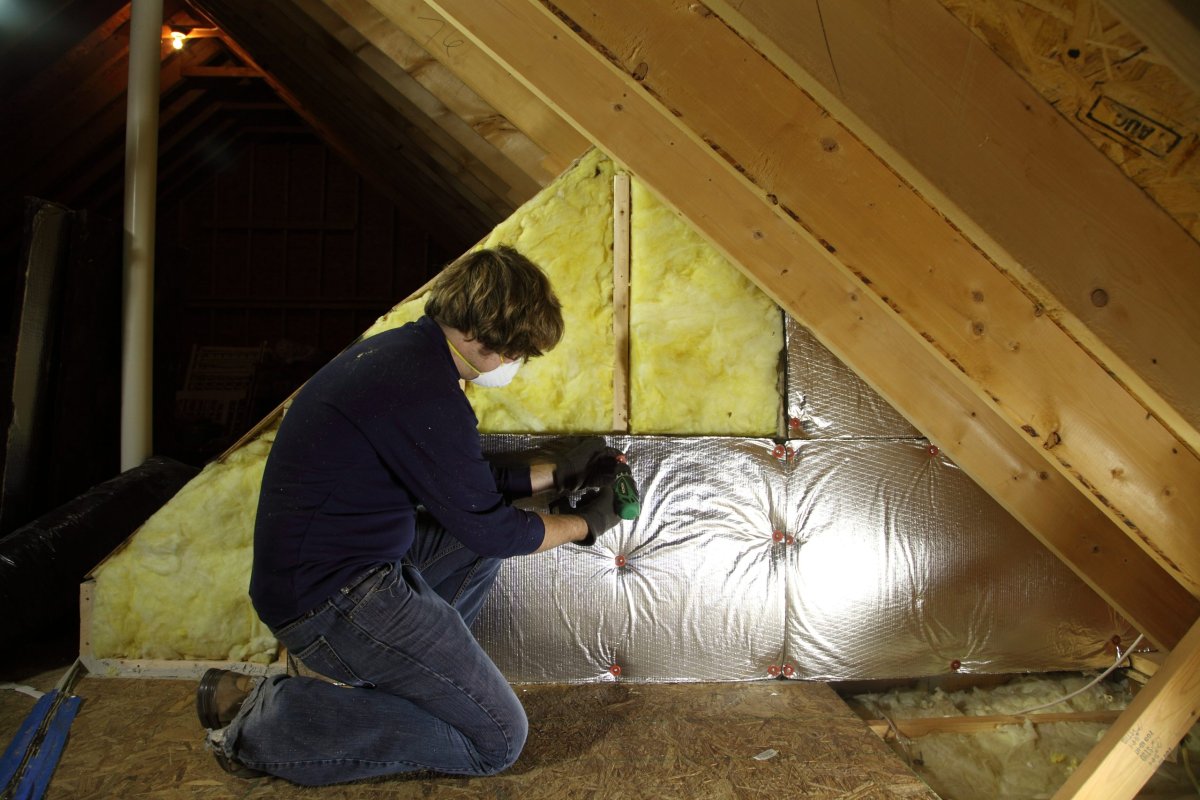
If the budget is limited, start with the areas that reduce losses before replacing equipment. In most cases, roof or attic insulation comes first, followed by walls, ground floors, ventilation, and only after that heating or domestic hot water. Windows alone improve comfort, but they almost never suffice on their own.
This logic is reflected in specialized content: Camif Habitat describes energy renovation as a set of works that can involve insulation of walls and joinery, ventilation, heating, and hot water production. Effy also states that insulation of attics, walls, and floors can generate up to 30% savings on the heating bill, depending on the initial condition of the home. This is an order of magnitude, not an automatic promise.

| Work | Main effect | When to prioritize | Common limitation |
|---|---|---|---|
| Insulation of attics or roof | Greatly reduces heat loss | When the roof is poorly or insufficiently insulated | Less gain if the roof is already treated |
| Insulation of walls and floors | Improves comfort and limits cold surfaces | In homes very sensitive to cold | Heavier and more costly work |
| Ventilation | Ensures healthy air after sealing | When there is humidity, condensation or odors | Does not reduce the bill alone, but prevents disorders |
| Heating and regulation | Optimizes remaining consumption | After reducing the home’s needs | A good device does not compensate for a faulty envelope |
| Windows | Improve comfort and some thermal bridges | If they are very old or poorly sealed | Often less priority than roof insulation |
The key point is that energy renovation does not have the same interest depending on the main defect of the dwelling. An old poorly insulated house will benefit more from treating its envelope than from changing a still adequate heating system. Conversely, an outdated or poorly adjusted system can become a priority once the building’s losses are contained.
A useful energy renovation starts by eliminating losses before replacing the heating equipment.
What order to follow to avoid mistakes?
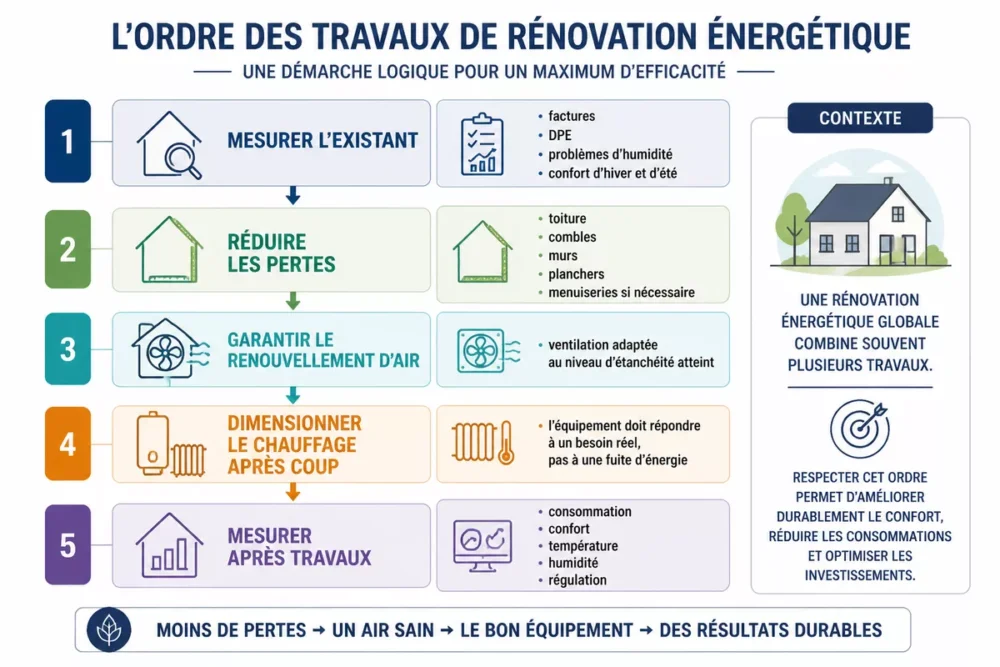
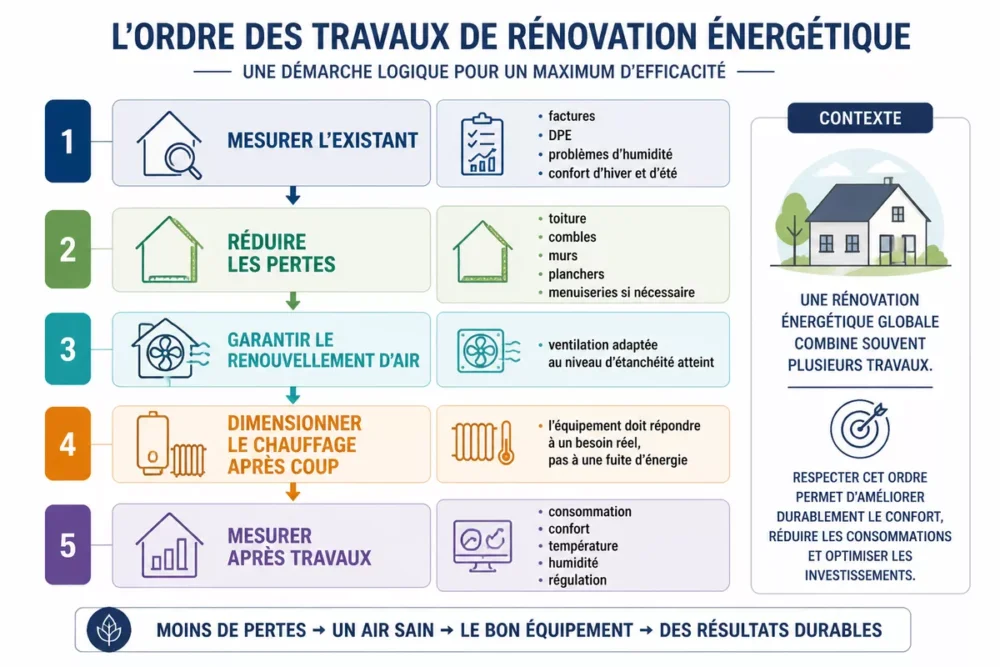
The right order is simple on paper: diagnose, insulate, ventilate, adjust heating, then check the results. In reality, many projects start with the most visible device, while the bill mainly depends on the heat demand. This is where energy renovation becomes a strategy, not just an addition of expenses.
- Measure the existing situation: bills, energy performance diagnosis (DPE), humidity problems, winter and summer comfort.
- Reduce losses: roof, attic, walls, floors, then joinery if necessary.
- Ensure air renewal: ventilation adapted to the level of airtightness achieved.
- Size the heating afterwards: the equipment must meet a real need, not an energy leak.
- Measure after work: consumption, comfort, temperature, humidity, and regulation.
This logic becomes even more important when talking about comprehensive energy renovation. In practice, it often refers to a project combining several works, for example insulation and ventilation, or envelope and heating. Camif Habitat also reminds that a comprehensive energy renovation is based on at least two works, which avoids settling for an isolated gesture without overall coherence.

Energy renovation is not a race to the most modern equipment, but a series of coherent decisions.
To avoid mistakes, remember a simple idea: a poorly ordered project often costs more because you have to go back. You can then oversize heating, replace windows too early, or neglect ventilation, which later creates new problems of condensation, comfort, and performance.
- Do not change the heating too early if the housing losses have not been addressed.
- Do not underestimate ventilation: a renovated but poorly ventilated home can deteriorate.
- Do not rely on a single quote: compare solutions and detailed items.
- Do not count solely on aid: it can change or be suspended.
What aids and checks should be done before signing?
The short answer: check the rules before starting the work, not after. Energy renovation aids can change, be capped, or depend on the type of housing, income level, the package of works, and the date the file is submitted. Some market information even indicates a suspension of MaPrimeRénov’ pending a 2026 government budget; this confirms that you should never build a financing plan on a single aid.
The aids often cited for energy renovation are MaPrimeRénov’, Anah supplements, the 5.5% VAT rate, and the eco-PTZ. Effy reminds that some of these schemes can be combined and cover up to 80% of the work for eligible households, but this reading remains a commercial guideline, not a universal commitment. At the same time, industry players emphasize that the quality of the craftsman and the coherence of the project matter as much as the aid itself.
| Source to verify | What it provides | How to use it |
|---|---|---|
| Service-Public and official texts | Rules, obligations, decent housing, schedule | Confirm your rights and constraints before starting the project |
| Anah and official aid pages | Amounts, eligibility conditions, documents to provide | Prepare a solid file without surprises |
| DPE and audit | Technical priorities of the housing | Choose the works that have a real effect on the bill |
| Quotes from qualified craftsmen | Actual cost, deadlines, materials, guarantees | Compare solutions item by item |
Before signing, always ask for a detailed quote, item by item, and check compatibility with the targeted aid. For energy renovation, the administrative chronology is almost as important as the technical chronology. A file submitted too late, an unsuitable craftsman, or a poorly written quote can cause loss of part of the funding.
If you have doubts, a good rule is to treat your project in three blocks: the technical need, the financing, then the execution. This is also where the distinction between owner-occupant, landlord, and co-ownership matters, as rules, levers, and deadlines are not the same.
How much can energy renovation really change the bill and the value of the property?
The most honest answer is: it depends on the starting point. A well-thought-out energy renovation can significantly reduce heating needs, improve comfort, and limit repeated work. The most visible gains often come from addressing losses, not from replacing an already adequate device. On the market side, the value gain is not automatic, but energy quality weighs more and more.
Effy states that a property rated A or B can sell on average 15 to 20% more than an equivalent property rated E, F, or G. This kind of gap should be read with caution, as it varies according to the area, general condition, and market tension. But it says something important: energy renovation no longer only affects the bill, it also influences the perceived quality of a home.

The weight of the residential sector in French final consumption also explains why this work returns to the center of trade-offs. In an electrically heated house, for example, even the slightest loss is quickly felt on the bill. The figures for the housing stock also show that about ten million main residences are heated by electricity, which makes the performance of the building envelope even more decisive.
Ultimately, energy renovation is less a “purchase” than a structural correction. It begins when one accepts that a poorly insulated home is not primarily fixed with a more powerful device, but with a better logic of work. It is this logic that sustainably lowers the bill.
Key Takeaways
- 🔍 Start with the housing diagnosis, not with the choice of equipment.
- 🏠 Prioritize insulation before heating when losses are significant.
- 🌬️ After insulation, ventilation becomes a must to preserve the building.
- 📄 Always check official aids before signing a quote.
- 📉 Successful energy renovation lowers the bill and limits sequencing errors.
FAQ
Is it always necessary to do an energy audit before the work?
Not necessarily for a small isolated action, but it is very useful as soon as the project becomes serious. The audit helps to choose the right order of work and avoid overinvesting in a low-priority item.

Is it better to insulate or change the heating first?
In most cases, it is better to reduce losses before replacing the heating. Otherwise, new equipment risks being poorly sized compared to the real needs of the home.
Is comprehensive energy renovation reserved for large budgets?
No, but it requires a true prioritization. It can be done in stages, provided that overall coherence is maintained between insulation, ventilation, and heating.
Do aids really cover a large part of the work?
Sometimes yes, but it is neither automatic nor stable. Conditions change, ceilings vary, and some schemes can be suspended; therefore, official pages must be checked before relying on them.
Does a better DPE rating necessarily increase the value of a home?
Not necessarily, but energy performance increasingly influences market perception. Value also depends on location, general condition, and quality of the work done.