Knowing when to sow vegetables in the vegetable garden is not just about following a month-by-month chart. The real challenge is to cross-reference three pieces of information: the season, the cultivation method — sowing in warmth, under cover, in a nursery, or directly in the ground — and the actual conditions of the garden. The same vegetable can be sown at different times depending on whether it is an early, summer, or winter variety.
The sowing calendar thus serves as a guide, not a strict rule. It helps avoid two common mistakes: sowing too early frost-sensitive vegetables that wither or die in the cold, and sowing too late vegetables that won’t have time to produce. The goal of this article is simple: to provide a clear method to plan sowing, adapt the dates to your climate, and organize regular harvests from spring to winter.
Table des matières
In brief
🌱 January to March is mainly for sowing in warmth or under cover: tomatoes, eggplants, peppers, celeries, early carrots, and the first cabbages depending on conditions.
🥕 April to June is the main period for the vegetable garden: beets, carrots, beans, lettuces, zucchinis, cucumbers, basil, and many plantings directly in the ground after frost risks.
🍂 July to September does not mark the end of sowing: it is the time to prepare chicories, lamb’s lettuce, autumn radishes, winter carrots, turnips, and vegetables to be harvested late.
🧭 The right calendar always depends on the local climate, the soil temperature, exposure, and the type of sowing: in warmth, under cover, in a nursery, or directly in place.
Why is the sowing calendar not always enough?
A calendar indicates an average period, but it does not know your soil, your altitude, or the actual date of the last frosts in your town. That is why two gardeners can sow the same carrots fifteen days apart and achieve good results. Specialized guides also remind that sowing periods depend on the local climate and soil, and that the weather must be checked before starting.
The calendar becomes truly useful when read as a decision grid. In January, for example, it does not invite sowing everything outdoors: it mainly signals possible crops under cover or in warmth. In May, it does not say that everything is risk-free: in cold areas, a late frost can still compromise tomatoes, zucchinis, or basils. The right question is therefore not only “when to sow vegetables,” but “under what conditions to sow this vegetable here, this week?”.
A reliable sowing calendar does not impose a date: it helps to choose the right cultivation method at the right time.
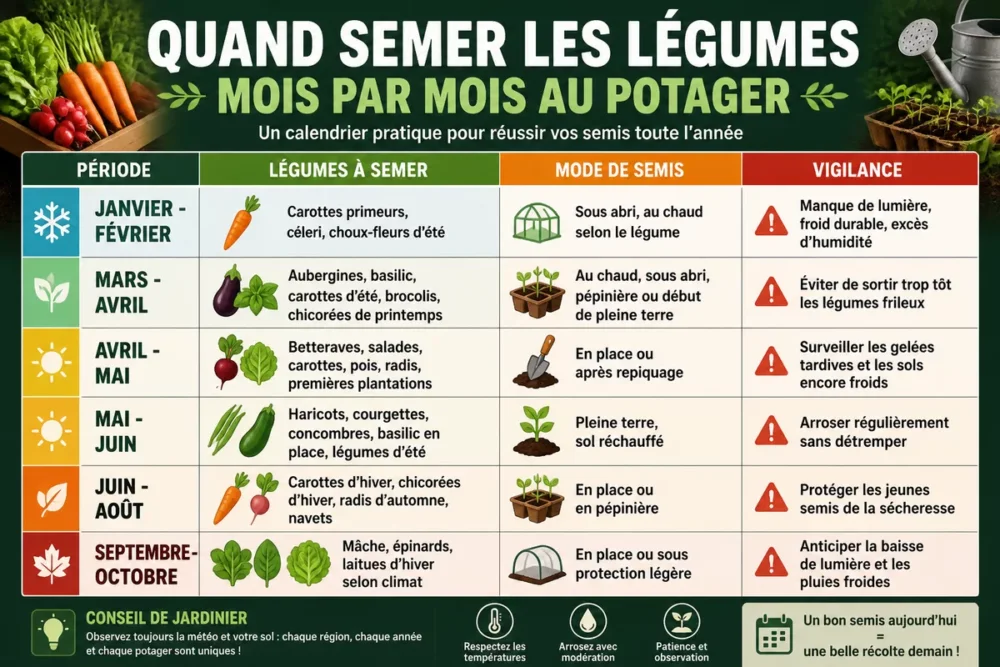
When to sow vegetables month by month in the vegetable garden?
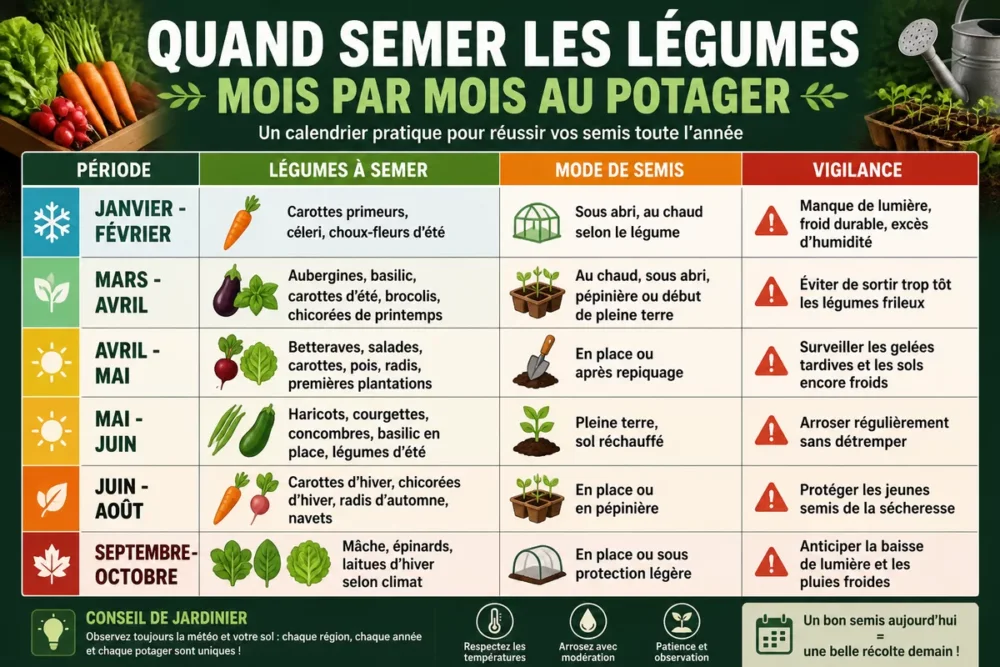
To know when to sow vegetables, use the month as a starting point, then adjust according to your region and your equipment. In winter, favor sowing in warmth or under cover. In spring, gradually expand sowing directly in the ground. In summer, think of autumn and winter vegetables rather than only immediate harvests.
| Period | Possible sowings | Recommended method | Points of caution |
|---|---|---|---|
| January – February | Early carrots, first celery sowings, summer cauliflowers | Under cover, warm depending on the vegetable | Lack of light, prolonged cold, excess moisture |
| March – April | Eggplants, basil, summer carrots, broccoli, spring chicories | Warm, under cover, nursery or early outdoor planting | Avoid putting out cold-sensitive vegetables too early |
| April – May | Beets, salads, carrots, peas, radishes, first plantings | In place or after transplanting | Watch for late frosts and still cold soils |
| May – June | Beans, zucchinis, cucumbers, basil in place, summer vegetables | Open ground, warmed soil | Water regularly without waterlogging |
| June – August | Winter carrots, winter chicories, autumn radishes, turnips | In place or in nursery | Protect young seedlings from drought |
| September – October | Corn salad, spinach, winter lettuces depending on climate | In place or under light protection | Anticipate decreasing light and cold rains |
This table provides a simple overview, but it is necessary to refine it vegetable by vegetable. For example, Rustica distinguishes several sowing methods — warm, under unheated cover, in nursery, or directly in place — in its calendar dedicated to 36 garden vegetables. This distinction is valuable because it avoids comparing indoor tomato sowing with radish sowing directly in open ground.
How to adapt the calendar to your region and actual weather?
Adapt the calendar by observing the risk of frost, soil warmth, exposure, and the speed of warming in your garden. In mild climates, some sowings start earlier. In cold, mountainous, or continental zones, it is better to delay sowings in place and use covers more extensively.
The year’s weather matters as much as the region. An exceptionally cold April is not managed like a mild and dry April. Seeds germinate poorly in too cold soil, and young plants stressed by cool nights fall behind. Willemse advises consulting the weather forecast and the product sheets for each plant before sowing: it is a simple rule, but often more useful than a calendar printed once and for all.
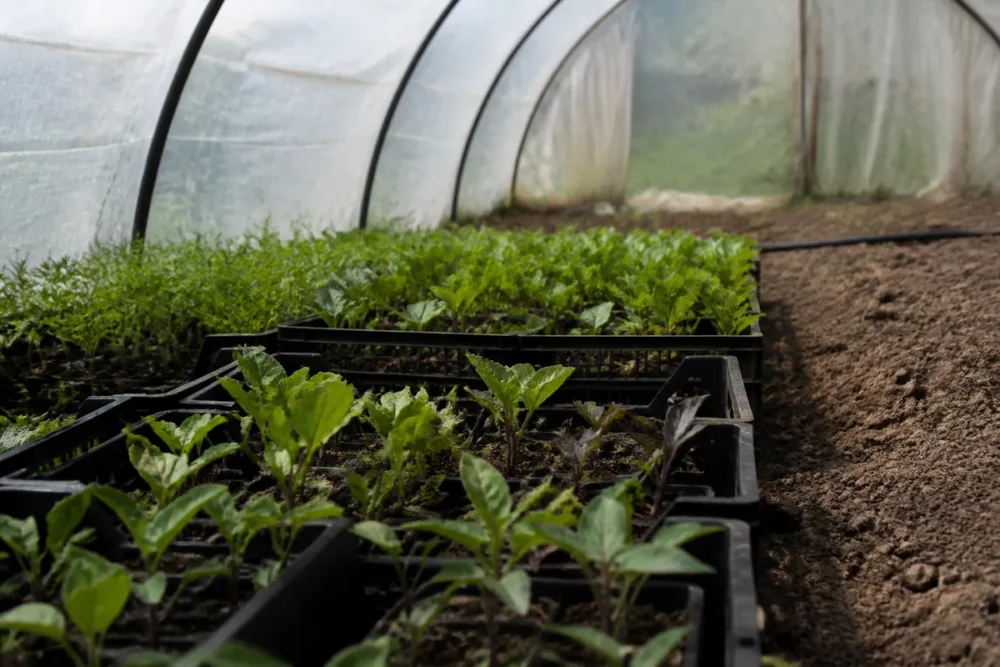
- North, East, altitude: wait more often for the soil to warm up and plan protections against cold nights.
- Oceanic West: mainly watch for excess moisture, slugs, and difficulty working waterlogged soil.
- South and mild coast: sowings can start earlier, but high heat requires staggered sowings and shading.
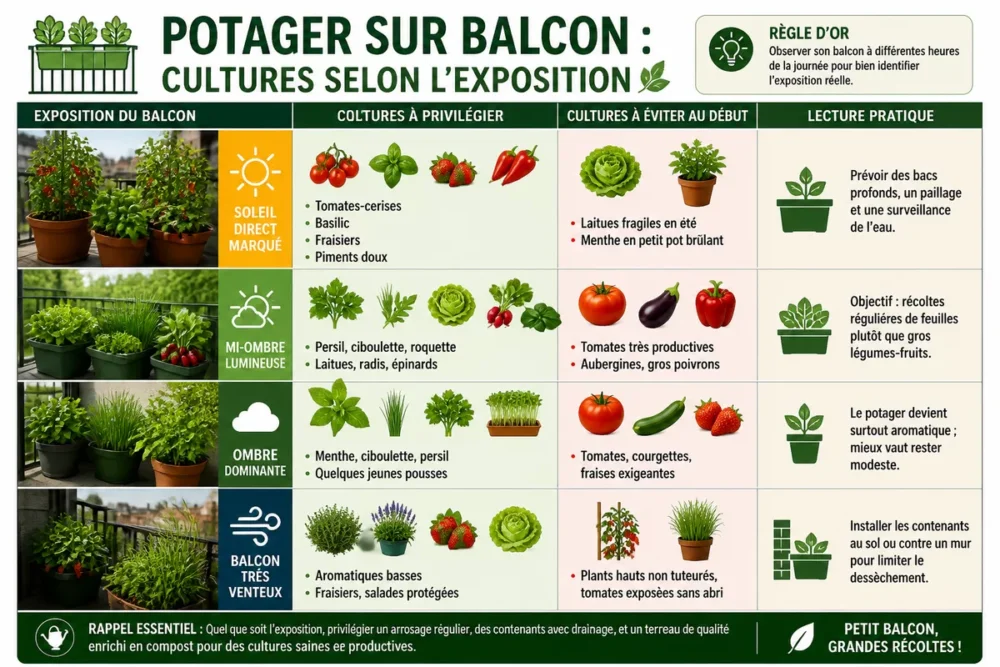
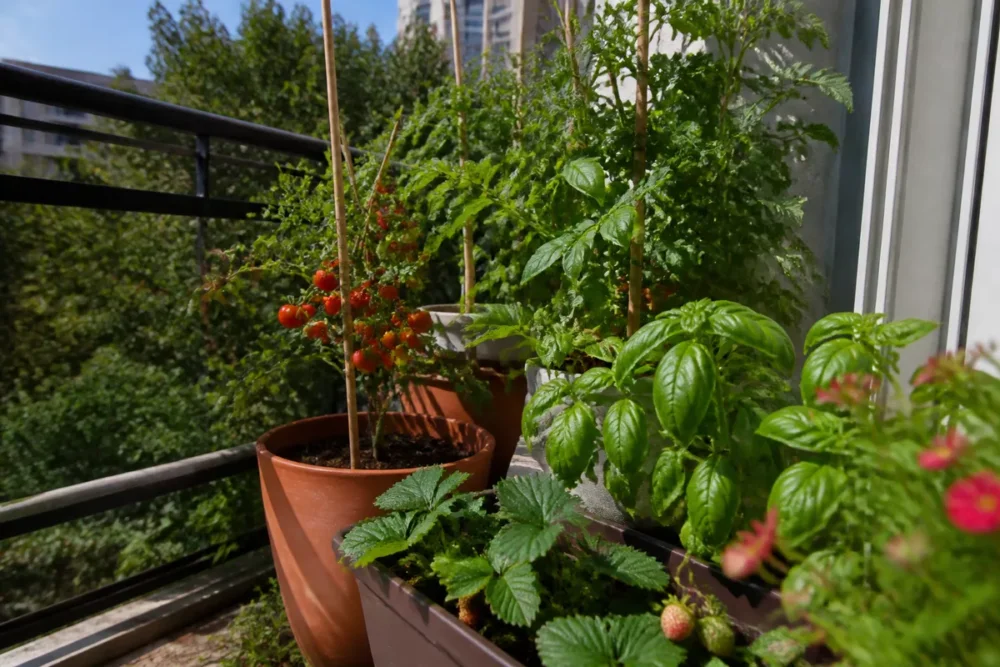
- Urban garden or balcony: containers warm up quickly but dry out faster than deep open ground.
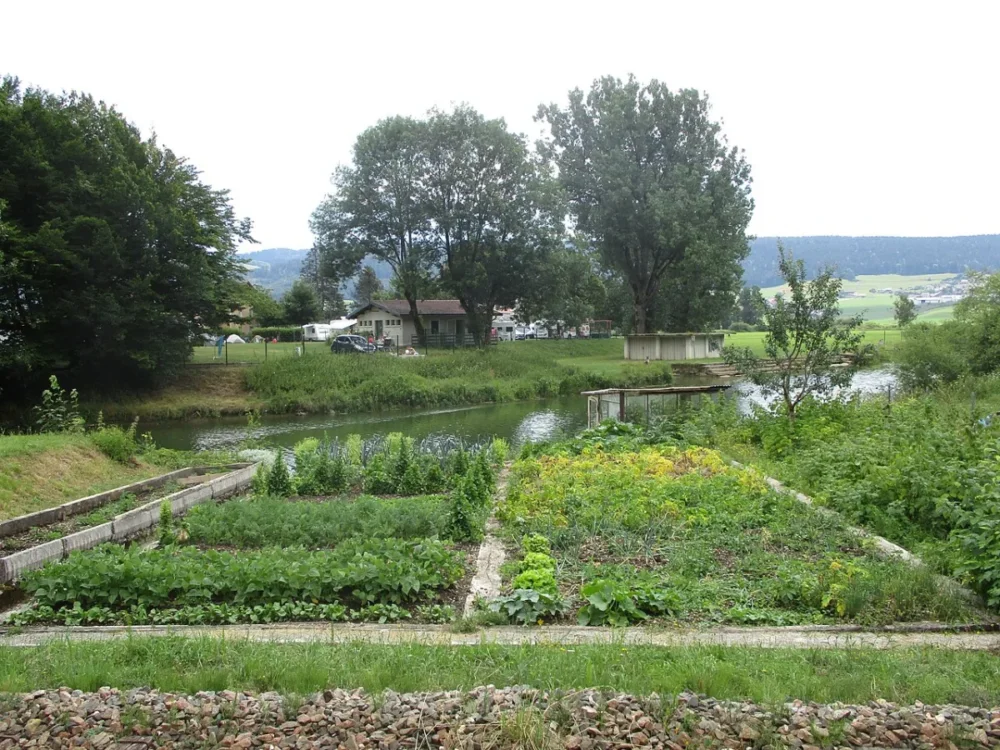
The terrain’s relief also affects sowing success: a damp lower garden, a slope exposed to wind, or a poorly drained area can alter the practical calendar. If your vegetable garden is on a sloped plot, water and erosion management becomes a priority; this guide for arranging a sloped garden can help stabilize the terrain before multiplying crops.
Which vegetables to sow in warmth, under cover, or directly in place?
Not all vegetables are sown in the same way. Sun-loving vegetables often need a warm start because their cycle is long and their growth requires heat. Conversely, many root vegetables do not tolerate transplanting well: carrots, radishes, or turnips are rather sown directly in place to avoid deforming the roots.
| Sowing method | Vegetables concerned | Advantage | Limitation |
|---|---|---|---|
| In warmth | Aubergine, chili pepper, tomato, basil, celery | Save time before the growing season | Needs light and a steady temperature |
| Under unheated cover | Early carrots, lettuces, some cabbages | Protect from cold rains and light frosts | Risk of excessive humidity if the cover is poorly ventilated |
| In nursery | Cabbages, leeks, chicories, salads | Produce seedlings to transplant at the right time | Requires an additional transplantation step |
| Directly in place | Carrot, radish, bean, beetroot, turnip, pea | Avoid transplanting stress | Strongly depends on soil condition and weather |
Examples from specialized calendars confirm this logic. Rustica notably indicates sowing aubergine from March to April in warmth, basil from March to April in warmth then in place from May, and beetroot from April to May directly in place. For carrots, the period varies depending on the goal: early carrots under cover in January-February, summer carrots under cover in March-April then in place from May, and winter carrots in place from June to August.
The right sowing is not just a matter of month: it is the harmony between the seed, the soil, the temperature, and the future transplanting.
How to organize your sowing to harvest longer?
To harvest longer, avoid sowing the entire packet at once. Staggered sowing consists of sowing small amounts every two to three weeks when the period allows. This method works very well for radishes, lettuces, carrots, beans, spinach, or beets.
It addresses a very concrete problem: abundance followed by emptiness. Sowing twenty lettuces on the same day often produces twenty lettuces ready almost at the same time, then nothing. By splitting the sowing, you spread out the harvests, limit losses, and better adapt the vegetable garden to your actual consumption. It is also a way to react to the weather: if one series of sowing fails due to a cold or dry spell, the next one can succeed.
- Choose 5 to 8 priority vegetables rather than trying to grow everything in the first year.
- Note the sowing period of each vegetable according to your climate and type of cover.
- Split fast-growing vegetables like radishes, lettuces, spinach, or beans into several small batches.
- Reserve space for the following crops even before harvesting the first ones.
- Keep a garden journal with date, weather, success, failure, and actual harvest date.
This approach creates a living calendar. At the end of autumn, you can prepare the main outlines for the following year: what you sowed too early, what lacked water, what produced too much at once, what deserves to be repeated. Rustica also recommends preparing the sowing calendar as early as the end of autumn, which leaves time to choose varieties and organize rotations.
What mistakes to avoid when figuring out when to sow vegetables?
The first mistake is to confuse possible sowing with recommended sowing. A date indicated on a packet or in a calendar assumes minimum conditions: dry soil, sufficient temperature, available light, appropriate protection. Sowing too early sometimes gives the impression of getting ahead, but seedlings that are stalled rarely catch up with a good sowing done two weeks later.
The second mistake is to neglect sowing depth and moisture. A seed buried too deep may lack the energy to sprout; a seed sown on the surface may dry out before germinating. The soil must remain cool without being waterlogged, especially for fine sowings like carrots or lettuces. Germination depends on a balance between moisture, warmth, and oxygen: too much water can be as problematic as too little.

- Sowing everything too early: chilly vegetables languish and occupy space unnecessarily for a long time.
- Forgetting thinning out: overcrowded plants produce small roots or weak leaves.
- Watering harshly: a strong jet displaces fine seeds and creates uneven emergence.
- Transplanting at the wrong time: a plant that is too young suffers, a plant that is too old recovers less well.
- Ignoring crop rotation: repeating the same families in the same place tires the soil and favors certain problems.
The simple calendar to follow to start without getting distracted
For a first vegetable garden, the best calendar is not the most complete, but the most readable. It is better to succeed with ten well-chosen vegetables than to follow an endless list. Start with easy crops spread over the year: radishes and lettuces in spring, tomatoes or zucchinis after the frosts, beans in warmed soil, carrots and beets in staggered sowings, lamb’s lettuce or spinach for autumn.
| Gardener profile | Priority | Recommended calendar | Mistake to avoid |
|---|---|---|---|
| Beginner with small vegetable garden | Quickly succeed with some harvests | Radishes, lettuces, beans, zucchinis, tomatoes as plants | Multiplying too many varieties from the first year |
| Gardener with greenhouse or veranda | Anticipate summer vegetables | Sowing indoors from late winter for tomatoes, eggplants, basil | Lack of light and getting leggy plants |
| Family vegetable garden | Stagger harvests | Small regular sowings of lettuces, carrots, beans, spinach | Sowing everything the same day and harvesting in excess |
| Garden in cool climate | Secure starts | Delay direct sowing, use shelters and nurseries | Copying a calendar designed for mild climate |
This simple calendar becomes more effective if you link it to your desired harvests. Do you mainly want summer vegetables? You need to prepare sowings or plants from late winter and spring. Do you want to eat from the vegetable garden in autumn? You need to sow in summer, at the time when many gardeners think the season is already over. It is this anticipation that turns a sowing calendar into a true production tool.
Useful sources to verify sowing dates
Gardening calendars are good guides, but they must be compared with the weather and variety indications. Seed packets often give details on the period, depth, spacing, and cultivation method. To compare, it is useful to consult several references, especially when you hesitate between sowing indoors, under cover, in nurseries, or directly in the ground.
| Source | Useful Information | How to Use It |
|---|---|---|
| Rustica | Sowing and harvesting calendar for 36 vegetables, with sowing methods | Compare periods according to vegetables and identify sowing indoors or directly in place |
| Willemse | Reminder of the importance of climate, soil, and local weather | Adjust general dates to the actual garden situation |
| Seed packets and variety sheets | Precise period, depth, spacing, indicative germination duration | Check the needs of the purchased variety rather than reasoning only by species |
| Personal vegetable garden notebook | Sowing dates, weather, success, observed harvest | Build a calendar adapted to your land year after year |
Key Takeaways
- 🌱 The calendar indicates a period, but local weather decides the right moment.
- 🧊 Tender vegetables are sown indoors before being planted outside.
- 🥕 Root vegetables do better when sown directly in place.
- 📆 Staggered sowing avoids massive harvests followed by empty periods.
- 📝 A garden notebook makes your calendar more reliable each year.
FAQ
When to sow the first vegetables in the garden?
The first sowings can start in winter under cover or indoors, but open ground often waits until the soil is less cold and less wet. To start simply, begin with radishes, lettuces, or early carrots under protection, then expand in spring.
Which vegetables to sow in March and April?
March and April are transition months. You can sow indoors vegetables like eggplants, basil, or tomatoes depending on equipment, and start some sowings under cover or directly in place like carrots, lettuces, beets, or cabbages depending on the climate.
When to plant tomatoes in the garden?
Tomatoes are generally planted after frost risks, in warmed soil and with sufficiently mild nights. The date varies greatly depending on the region: it is better to wait a few more days than to plant too early in cold soil.
Can vegetables be sown in summer?
Yes, summer is an important period to prepare autumn and winter harvests. You can notably sow winter carrots, chicories, autumn radishes, turnips, lamb’s lettuce, or spinach depending on the regions and available moisture.
Should the lunar calendar be followed for sowing?
Some gardeners use the Moon as a complementary guide, but it does not replace basic conditions: ready soil, suitable temperature, regular moisture, and well-chosen variety. For a beginner, these practical criteria should remain a priority.