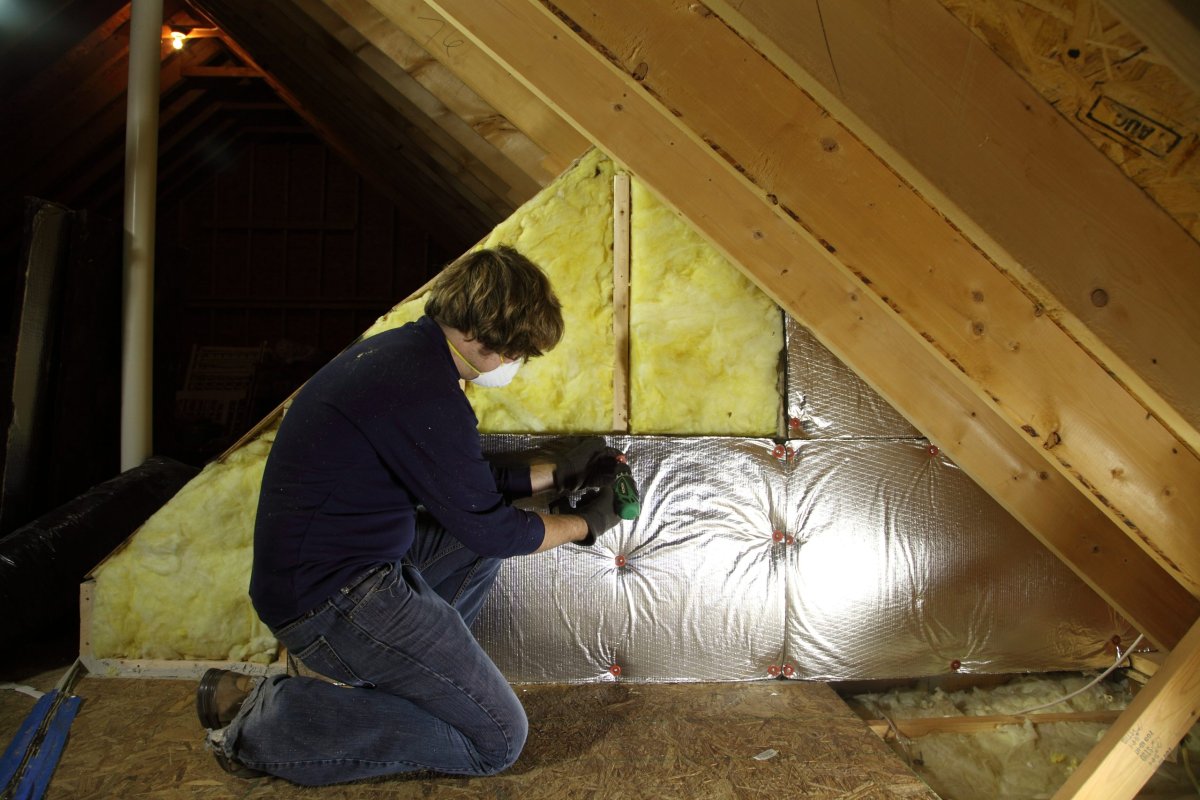
A thermal sieve is not just a “cold” home: it is a property whose envelope lets heat escape too easily, which often results in high bills and lasting discomfort. To know if your home is affected, the first indicator to check is the DPE: in practice, classes F and G are the clearest warning signal.
But the diagnosis does not tell the whole story. Two homes classified the same way can feel very different depending on insulation, ventilation, exposure, or surface area. That is why you need to look at both the energy label, visible signs in the home, and the regulatory framework, especially if you rent, buy, or prepare for renovation.
Table des matières
In brief
🔎 The DPE is the simplest indicator: a home rated F or G is generally a thermal sieve.
🏠 The alert does not come only from the diagnosis: humidity, cold walls, condensation, and high bills also count.
⚖️ In rentals, the issue has become concrete: G homes have been banned from rental since January 1, 2025, F will follow in 2028, then E in 2034.
🛠️ To solve the problem, you need to think in the right order: envelope, ventilation, then heating.
How to quickly know if a home is a thermal sieve?
The most reliable answer is to start with the DPE: if the home is rated F or G, it is very likely affected. Then, you need to check if this poor performance is really felt daily, because a rating alone does not tell everything about comfort, actual use, and causes of the problem.

The most useful is therefore to cross three levels of reading: the DPE label, symptoms in the home, and the applicable rule if the property is rented or put up for sale. This crossing avoids errors in judgment, especially when a home “seems okay” but consumes far too much.
| Observed indicator | What it might mean | Useful check |
|---|---|---|
| DPE rated F or G | The home is very likely a thermal sieve | Read the diagnostic details and the origin of losses |
| High bills despite “normal” heating | Significant heat loss or low system efficiency | Compare several months of consumption |
| Cold walls, condensation, drafts | Insufficient insulation or ventilation | Check joinery, thermal bridges, and ventilation |
| Persistent discomfort in winter and summer | Building envelope too weak | Request a more detailed technical reading |
- Start with the DPE: it provides the clearest framework.
- Look at the bills: they confirm or refute the suspicion.
- Observe the real comfort: cold, humidity, and overheating are good signals.
- Do not confuse powerful heating with a good home: a large boiler does not always compensate for a poor envelope.
According to the ONRE, about 5.2 million homes, or 17% of the main residence stock, were thermal sieves in France as of January 1, 2022. The issue is therefore massive: it does not concern a marginal minority, but a significant part of the existing stock.
What concrete signs should alert you in the housing?
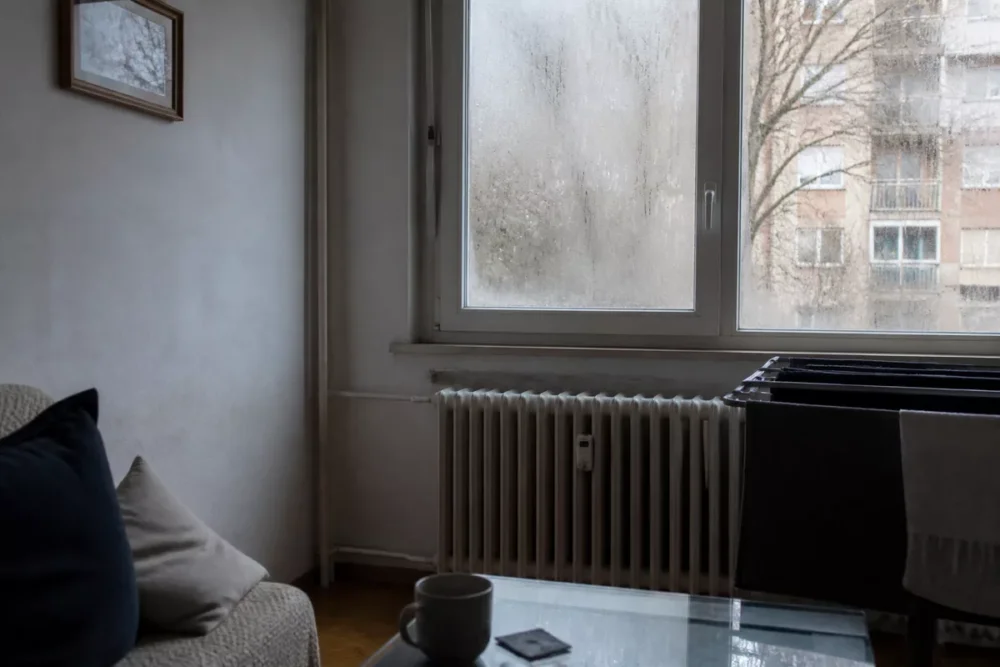
Visible signs do not replace the DPE, but they are valuable to confirm a doubt. If you feel a clear difference between rooms, if the walls remain cold, if condensation often returns, or if the housing requires a lot of heating without lasting results, you need to investigate further.

In an affected housing, complaints often revolve around a few recurring symptoms. The real warning sign is not an isolated detail, but the accumulation of small clues that tell the same story: heat escaping, humidity settling in, and a heating system that compensates without ever catching up.
- Drafts near windows, doors, or shutter boxes.
- Cold walls to the touch, especially on the facade or corners.
- Regular condensation on windows or in damp rooms.
- Unstable temperatures from one room to another.
- Heating heavily used without a lasting feeling of comfort.
- Musty odors or visible marks on some walls.
A thermal sieve is rarely identified by a single clue. It is the repetition of the same symptoms that turns a doubt into a serious signal.
The most misleading case is that of a housing that “heats up quickly” but loses its heat just as fast. One then has the impression of running the heating normally, whereas the problem primarily comes from losses and not from the installed power. It is precisely this type of situation that prompts checking the quality of insulation before any equipment replacement.
How to read a DPE without making a mistake?
The DPE is first read as a global performance benchmark, not as a simple verdict. A grade F or G indicates a very energy-consuming housing, but you must then look at the main cause: insulation, ventilation, windows, heating, or localized losses. This reading helps decide what to do next.
The common trap is to stop at the letter without reading the details. Yet the diagnosis often indicates where energy is lost, which changes everything for what follows. A housing can be penalized by the building envelope, by insufficient ventilation, or by an ill-adapted heating system, and the priority of works will not be the same.
| DPE Class | Practical reading | Alert level |
|---|---|---|
| A to C | Generally efficient housing | Low |
| D | Intermediate zone, to be analyzed according to actual comfort | Medium |
| E | Beginning of energy fragility, to be closely monitored | High |
| F to G | Housing probably affected by a thermal sieve | Very high |
The right reflex is not to ask “what is the grade?”, but “what explains this grade?”.
What do the rules change if you rent, sell, or live in the housing?
The answer depends on your situation, because a thermal sieve does not have the same consequences for an owner-occupier, a landlord, or a buyer. In rental, the issue is regulatory; in sale, it becomes a matter of information and negotiation; for the occupant, it mainly helps decide whether to renovate or not.
In France, housing rated G has been banned from rental since January 1, 2025, housing rated F will be banned starting 2028, and housing rated E starting 2034. In overseas territories, the schedule is different: housing rated G is concerned by non-decency starting 2028 and housing rated F starting 2031.
| Situation | What it changes | Useful reflex |
|---|---|---|
| Landlord owner | The regulatory schedule becomes a direct constraint | Check the DPE before any re-rental |
| Buyer | The price must be read with the cost of works | Request an audit or a renovation estimate |
| Occupying owner | The issue is primarily economic and comfort-related | Prioritize the works before investing |
| Seller | The DPE influences the perceived value of the property | Prepare a clear file on the weaknesses of the housing |
Sales or rental ads concerning housing classified F or G must also indicate that they have excessive energy consumption. In other words, the thermal sieve is no longer just a technical issue: it is also a matter of transparency in the market.
What checks to make before concluding that your home is affected?
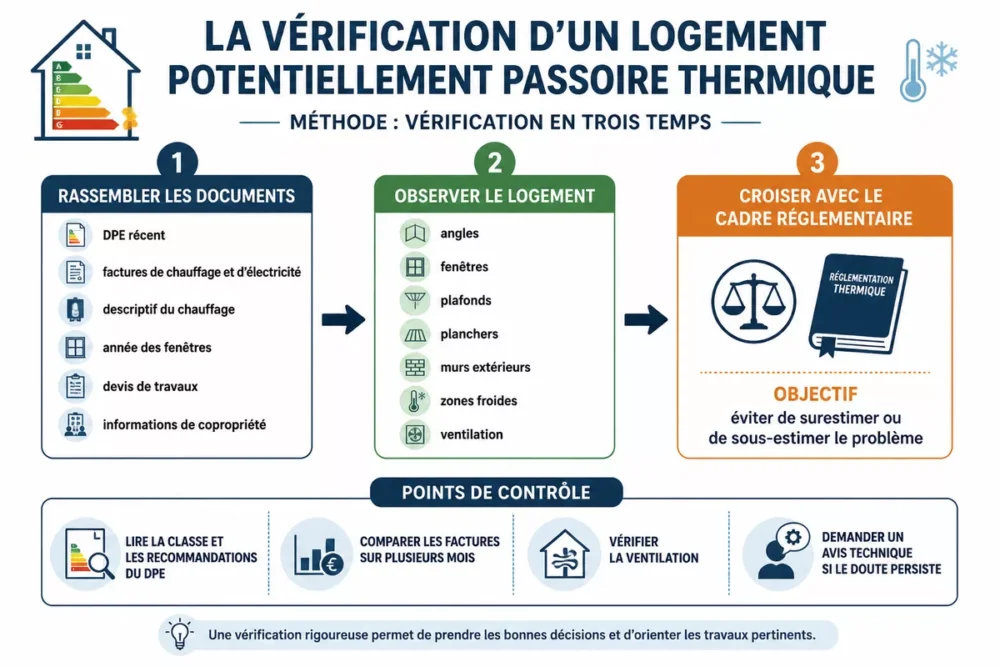
Before concluding too quickly, a three-step check must be made: gather the documents, observe the housing, then cross-check with the regulatory framework. This method avoids two opposite errors: overestimating a problem that is not one, or underestimating a clearly energy-consuming property.
- Find the DPE and read the rating, but also the associated recommendations.
- Compare heating and electricity bills over several months.
- Inspect cold spots: corners, windows, ceilings, floors, exterior walls.
- Check the ventilation: poor extraction can worsen humidity and discomfort.
- Request a technical opinion if doubt persists, especially before purchase or major renovation.
The most useful documents are often simple to gather: DPE, old bills, heating description, window year, possible work estimates, and, in co-ownership, information on common areas. It is from this set that one can distinguish a one-off problem from a real structural defect.
- Recent DPE: the starting point.
- Bills: they show the real effect on the budget.
- Estimates or audit: they turn doubt into an action plan.
- Photos of defects: they help objectify the observations.
How to get out of a thermal sieve without doing the wrong work?
The fundamental point is that a thermal sieve is not treated by changing only one piece of equipment. If the housing envelope lets heat escape, a new heating system can reduce the bill a little, but it does not solve the underlying problem. The logical order is generally: insulation, airtightness, ventilation, then heating.

| Work | Main role | Priority | Limit to keep in mind |
|---|---|---|---|
| Insulation of attics or roof | Reduce a significant part of losses | Very high | Not enough if walls or windows are very weak |
| Insulation of walls or floors | Improve thermal stability | High | Can be more complex in co-ownership |
| Carpentry | Limit drafts and discomfort | Depending on actual condition | Window replacement is not always a priority |
| Ventilation | Evacuate humidity and purify the air | High | Good insulation without proper ventilation creates other problems |
| Heating system | Adapt heat production | After envelope diagnosis | A new system does not compensate for a very faulty envelope |
Renovating a thermal sieve is not about stacking equipment: it is first about correcting what causes energy to escape.
The right trade-off also depends on the type of housing. In a detached house, the room for maneuver is often wider. In co-ownership, works are sometimes conditioned by collective decisions, which requires prioritizing what can be done quickly at the private scale and what concerns common areas.
Buying a thermal sieve: risk or opportunity?
Both exist. A thermal sieve can offer a discount at purchase, but only if the renovation is realistic, quantified, and compatible with the use of the property. The right purchase is therefore not the one that seems “cheap” at first, but the one whose total cost remains coherent after works, contingencies, and upgrades.
For a buyer, the useful question is not “is the property a thermal sieve?”, but “do I have the means to get it out of this state without misprioritizing?”. This nuance changes everything, because a poor estimate of the works can turn an attractive deal into a costly and long project to stabilize.
| Purchase profile | Risk assessment | Prudent decision |
|---|---|---|
| First purchase with tight budget | High risk if works are heavy | Avoid without solid audit |
| Investor with renovation capacity | Possible opportunity if discount covers the works | Quantify total cost before bidding |
| Occupying buyer ready to stay long-term | Future comfort may justify the initial effort | Prioritize lasting gains |
| Property in already complex co-ownership | Risk of depending on collective decisions | Check co-ownership constraints |
In all cases, an energy audit or a serious technical reading is preferable to a decision based solely on the asking price. A well-identified thermal sieve negotiates better than a property whose defects are poorly understood, because the works then become a visible cost line and not a surprise.
The market movement also confirms that the question is no longer marginal. When a significant part of the stock is concerned, the issue becomes a criterion of sorting, value, and timing, not just a matter of comfort or ecology.
Useful sources to check a particular case
For a specific case, it is always necessary to refer back to official benchmarks: ANIL for the practical framework of rental, Service-Public for rules and procedures, and documents related to the DPE for reading the housing. This trio is often enough to clarify if the property is concerned and at what level of urgency.
- ANIL: practical guidelines on energy-inefficient housing and rental.
- Service-Public: administrative rules and landlord obligations.
- DPE: technical basis for assessing housing performance.
If you are still unsure, the right approach is not to ask “is it serious?”, but “what does this housing cost me today, and what will it cost me tomorrow if I do nothing?”. It is often this question that shifts the decision towards a thorough check rather than a rough intuition.
Key points to remember
- The DPE remains the first filter to spot a thermal sieve.
- Classes F and G are the clearest signals.
- Visible signs confirm the diagnosis: cold, humidity, drafts, high bills.
- In rental, the rules have become much more restrictive.
- The right technical response starts with the building envelope, not heating.
- Buying a thermal sieve can be justified, but only with a detailed renovation plan.
To remember
- 🔎 A F or G rated home deserves immediate verification.
- 🏠 Daily symptoms often confirm poor performance.
- ⚖️ Renting an energy-inefficient home follows a precise schedule.
- 🛠️ Proper renovations start by reducing losses, not by changing heating.
- 💶 A purchase is only interesting if the total cost remains manageable after renovation.
FAQ
How can I tell if my home is a thermal sieve without doing renovations?
The simplest way is to check the DPE and compare it with daily symptoms: cold, humidity, drafts, and high bills. If the home is rated F or G, doubt is usually removed. In case of uncertainty, a more detailed technical reading remains useful.
Is a home rated E already a thermal sieve?
Not in the most common sense of the term, but it can be fragile energy-wise. Regulations primarily target classes F and G, but an E can still indicate a future need for renovation, especially if comfort is poor or bills are high.
Is the DPE alone sufficient to conclude?
It provides the most reliable basis, but it is not always enough. Two homes with the same rating can behave differently depending on ventilation, exposure, or layout. That is why the DPE should always be cross-checked with visible signs and, if necessary, a technical opinion.
What should I prioritize if my home is concerned?
You should start with heat losses: insulation, airtightness, thermal bridges, then ventilation. Heating comes afterwards. If you reverse the order, you risk paying for a more efficient system without addressing the main cause of the problem.
Can I buy a thermal sieve without taking too many risks?
Yes, but only if the purchase price, renovation costs, and renovation schedule are coherent. Without an audit or serious estimate, the risk is high. The opportunity exists, but it depends less on the word “sieve” than on your ability to quickly bring it out of that state.